

Table of contents
If you have ever asked three different agencies in Nairobi for a website quote, you probably received three wildly different numbers. One might say KES 25,000. Another might say KES 120,000. A third might quote more than KES 300,000 for what sounded like the same project. It is natural to wonder whether somebody is overcharging, or whether the cheapest quote is the only honest one.
The truth is that “a website” is not a single product. It is closer to asking “how much does a building cost?” without saying whether you want a kiosk, a family home or a shopping mall. The price depends on what you need the website to do, who builds it, how long it takes, and how well it is built to last.
This guide explains website design cost in Kenya as we head into 2027. It covers typical price ranges, what actually drives those prices, the hidden costs that catch business owners by surprise, and how to set a sensible budget. By the end, you should be able to read a quotation with confidence and know what you are paying for.
A quick note before we start: the figures in this article are realistic market ranges based on what agencies, freelancers and hosting companies in Kenya commonly publish and quote. They are guides, not fixed prices. Exchange rates, inflation, platform pricing and the scope of your project will all move the numbers, so always get a written quotation for your specific needs.
The short answer: typical website costs in Kenya
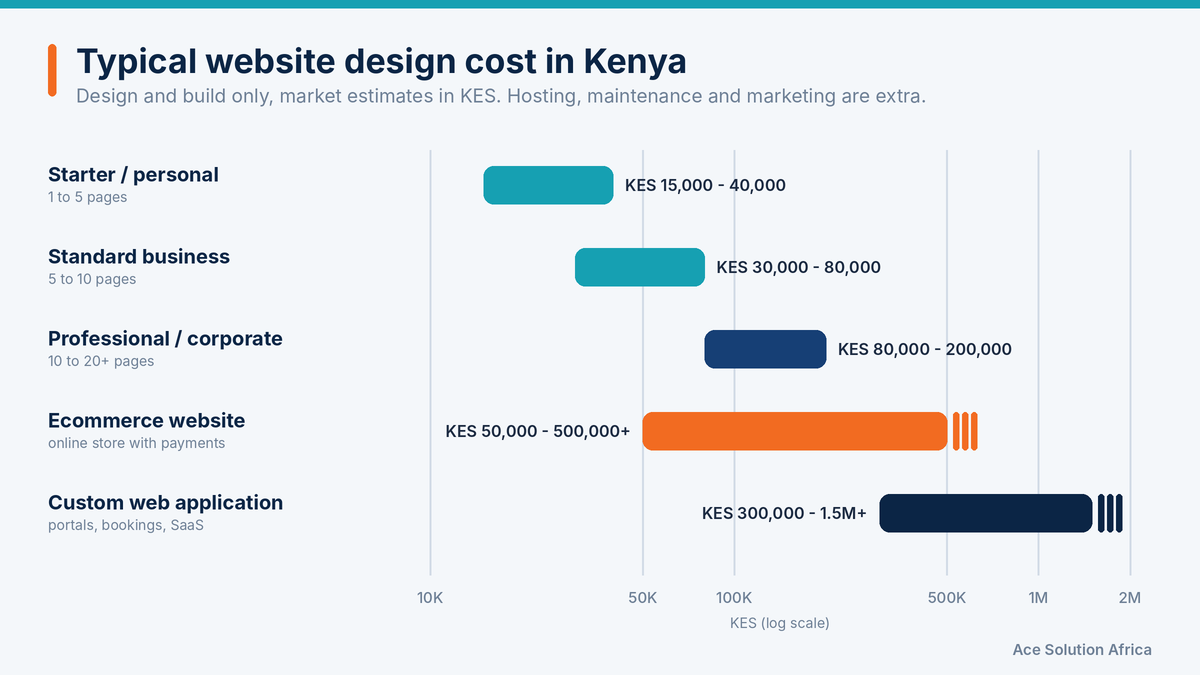
Here is a quick overview before we go deeper. These are broad ranges for the design and build only, and they do not include ongoing costs such as hosting, domain renewals, maintenance and marketing.
| Type of website | Typical range (KES) | Who it suits |
|---|---|---|
| Simple starter or personal site (1 to 5 pages) | 15,000 to 40,000 | Freelancers, consultants, very small businesses, portfolios |
| Standard business website (5 to 10 pages) | 30,000 to 80,000 | Small service businesses, shops, clinics, schools |
| Professional or corporate website (10 to 20+ pages) | 80,000 to 200,000 | Established companies, NGOs, hotels, real estate firms |
| Ecommerce website | 50,000 to 500,000+ | Businesses selling products online |
| Custom web application or portal | 300,000 to 1,500,000+ | Booking platforms, fintech tools, marketplaces, SaaS |
Notice how wide those ranges are. A business website at KES 35,000 and one at KES 180,000 can both be described as “a business website,” yet they are very different products. The rest of this guide explains where that gap comes from.
If you want a broader look at what a professional agency delivers, you can explore our overview of website design in Kenya to see how a typical project is structured from discovery through launch.
What you are really paying for
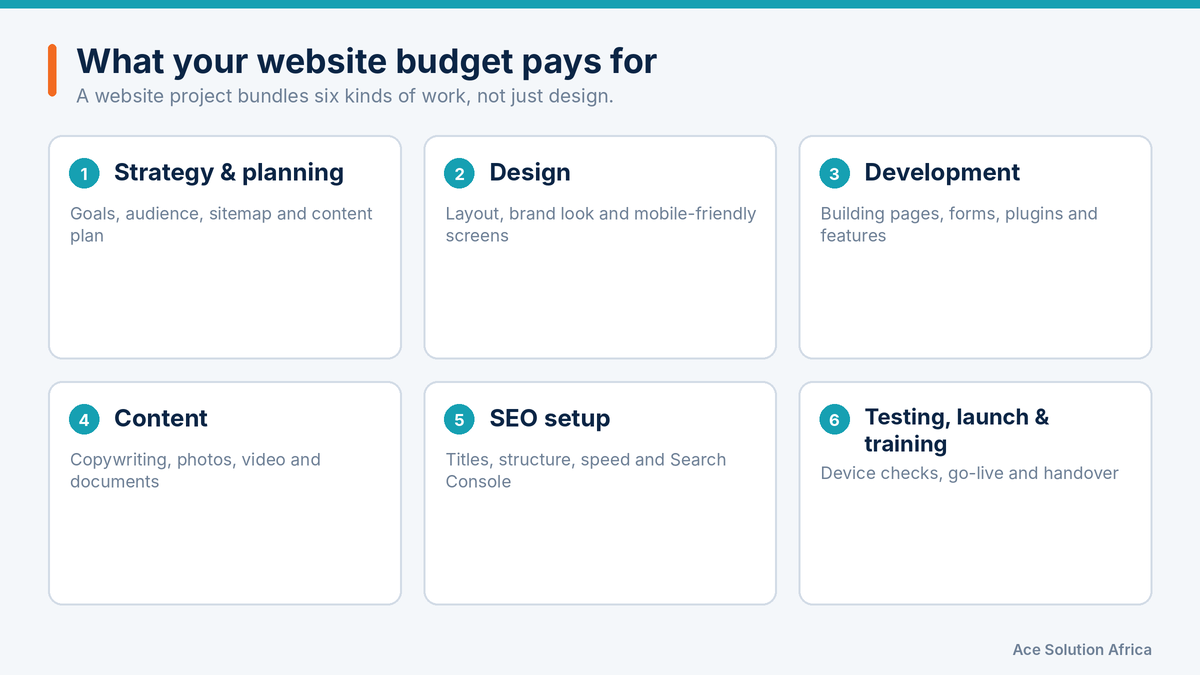
Many business owners picture website cost as “the cost of the design.” In reality, a website project bundles together several different kinds of work. Understanding them makes quotes much easier to compare.
1. Strategy and planning
A good website begins long before anyone opens design software. Someone has to understand your business, your customers, your competitors and your goals. What should a visitor do when they land on your homepage? Call you? Book a visit? Buy something? Request a quotation?
Planning produces a sitemap (the list and structure of your pages), a content plan and a clear set of goals. Cheap websites often skip this step, which is why they look fine but do not generate enquiries.
2. Design
Design covers the look and feel: layout, colours, typography, imagery and how everything adapts to phones, tablets and desktops. Design can be built on a pre-made template, adapted from a template with significant changes, or created from scratch to match your brand.
Template-based design is faster and cheaper. Fully custom design takes more hours, more revisions and more senior skill, so it costs more. Neither is automatically better. A well-chosen, well-customised template can serve a small business perfectly. A custom design earns its cost when brand differentiation and conversion matter a great deal.
3. Development
Development is the technical build that turns the design into a working website. This includes setting up the content management system (such as WordPress), building page templates, installing and configuring plugins, making forms work, connecting email, and ensuring the site loads quickly.
The more custom features you need, such as booking engines, member areas, quote calculators, multi-language support or integrations with other systems, the more development time is involved.
4. Content
Content is the text, photos, videos and documents on your site. Some agencies include basic copywriting; many expect you to supply it. Professional copywriting, photography and video can easily add tens of thousands of shillings to a project. Weak content is one of the biggest reasons otherwise good websites underperform, so do not treat it as an afterthought.
5. Search engine optimisation (SEO) setup
Basic on-page SEO means proper page titles, meta descriptions, heading structure, image optimisation, clean URLs, sitemap submission and fast loading. A professional build should include this foundation. Ongoing SEO, such as publishing articles and building links, is a separate monthly service.
6. Testing, launch and training
Before launch, the site should be tested across devices and browsers, forms and payments should be checked, and security basics should be in place. After launch, you should be shown how to update your own content. Good agencies include some handover or training. Rushed ones hand you a login and disappear.
The main factors that drive website design cost in Kenya
Now that you know what goes into a project, here are the factors that push a price up or down.
The number of pages
More pages mean more design, more development and more content work. A five-page site (Home, About, Services, Blog, Contact) is a very different job from a 40-page site with service sub-pages, location pages, team profiles and case studies.
The type of functionality
Functionality is usually the biggest cost multiplier. A brochure website that simply presents information is the cheapest. Add any of the following and the cost rises:
- Online shop with product catalogue and checkout
- M-Pesa, card or bank payment integration
- Online booking or appointment scheduling
- Customer accounts and dashboards
- Job boards or listings
- Membership or e-learning features
- Multi-currency or multi-language support
- Integration with accounting, CRM or inventory software
Design complexity and customisation
A site built from a premium template with your logo and colours might take 20 to 40 hours. A fully custom design with bespoke illustrations, animations and unique page layouts can take several times as long.
The experience of the people building it
In Kenya you will meet three broad types of providers: freelancers, small agencies and larger agencies or software houses. Freelancers can offer excellent value, especially for simple projects, but quality varies enormously and there may be a single point of failure if they become unavailable. Established agencies cost more because they carry overheads, employ specialists (designers, developers, SEO and project managers) and typically provide structured processes and support. Larger firms serving corporates and government add compliance, documentation and security practices that smaller projects may not need.
You are paying for experience, reliability and accountability as much as for the website itself.
Timeline
Rush projects cost more. If you need a site in a week, an agency may have to reshuffle its team or work overtime, and that is usually reflected in the price. Realistic timelines for a standard business website are often two to six weeks, depending on how quickly you provide content and feedback.
Content readiness
Delays in providing text and images are one of the most common causes of overruns. If your content is not ready, you either pay for content creation or accept a slower project.
Platform choice
The platform you build on affects both initial and long-term cost. WordPress is the most widely used and is cost-effective for most businesses. Shopify and similar hosted platforms charge monthly subscriptions. Fully custom-coded sites (for example in Laravel, Node.js or Django) cost more up front but offer maximum flexibility. We cover this decision in more depth in our article on WordPress versus custom website development in Kenya.
Website cost by business type
Different kinds of businesses tend to have different needs, so here is how budgets commonly play out.
Freelancers, consultants and personal brands
A personal website usually needs a homepage, about page, services, a portfolio or testimonials, and a contact page. A budget of roughly KES 15,000 to 50,000 is common. The priority is professional credibility and an easy way for clients to contact you.
Small shops, restaurants and local services
These businesses need clear information, photos, opening hours, a map, a menu or price list, and possibly WhatsApp or call buttons. A typical range is KES 30,000 to 90,000. If you want online ordering or booking, expect a higher figure.
Schools, clinics and professional firms
Trust and clarity matter most. These sites often need team pages, service pages, downloadable documents, appointment forms and sometimes parent or patient portals. A common range is KES 60,000 to 200,000, rising with portal functionality.
Hotels, lodges and tour operators
Tourism websites rely heavily on high-quality imagery, booking enquiries or live booking engines, multilingual content and strong SEO. Budgets often run from KES 80,000 to 300,000 or more, depending on booking integrations.
Real estate companies
Property sites need listings with search and filters, galleries, maps and enquiry forms. They are usually more complex than a standard business site, with budgets frequently starting around KES 100,000 and climbing with features.
NGOs and non-profits
NGO sites often need donation functionality, project and report libraries, multilingual content and accessibility features. Donor-facing credibility matters, and budgets of KES 80,000 to 250,000 are common.
Online stores
Ecommerce is its own category because of payments, inventory, shipping and security. We have written a separate guide on ecommerce website development costs in Kenya, but as a rule of thumb, a functional store with M-Pesa checkout starts in the tens of thousands of shillings and can exceed KES 500,000 for large catalogues and custom features.
Not sure which budget fits your business?
Tell us what your website needs to achieve and we will recommend a realistic scope, timeline and price, with nothing hidden.
The hidden and ongoing costs people forget
The build price is only the beginning. A website is a business asset that needs running costs, just like a shop needs rent and electricity. Here are the recurring items to include in your budget.
Domain name
A domain name is your web address. A .co.ke domain commonly costs from a few hundred to a few thousand shillings per year depending on the registrar and promotions, while .com domains are in a similar range. Renewal prices can be higher than first-year promotional prices, so check them.
Web hosting
Hosting is the server space where your website lives. Shared hosting for small sites can cost from a couple of thousand shillings per year to around KES 15,000 per year, depending on performance and provider. VPS or managed hosting costs more but delivers better speed and security, and dedicated hosting is higher still. For a business that depends on its website, quality hosting is not the place to cut corners, because slow or frequently offline sites lose customers and search rankings.
SSL certificate
An SSL certificate encrypts data between your visitor and your site and gives you the padlock and “https” in the address bar. Many hosts include a free SSL certificate, but some charge for premium certificates.
Business email
Professional email addresses such as info@yourcompany.co.ke build trust compared with free webmail addresses. Some hosting plans include email; others use paid services such as Google Workspace or Microsoft 365, which are billed per user per month.
Maintenance and security
Websites need regular updates to the core software, themes and plugins, plus backups, security monitoring and uptime checks. Neglected sites become targets for hackers. Maintenance plans from agencies commonly range from a few thousand shillings per month for basic care to considerably more for active support and content updates. If you do not budget for maintenance, you are effectively accepting the risk of a broken or compromised site.
Premium themes, plugins and licences
Some themes, page builders, form tools, security plugins, booking systems and SEO plugins carry annual licence fees. Ask your provider which licences are included and who owns them. You want licences registered in your name or a clear arrangement for renewal.
Stock photos, video and copywriting
If you do not have your own photography, stock images can be free or paid. Professional photo and video shoots cost more but make a visible difference, especially for hospitality, real estate, fashion and food businesses.
Payment gateway costs
If you take payments online, there are transaction fees to consider. M-Pesa and card payment providers charge fees per transaction, and gateways such as Pesapal, Flutterwave or others have their own fee structures. Some also have setup costs.
Marketing and SEO
A website does not market itself. Many businesses launch a good site and then wonder why nobody visits. Budget for search engine optimisation, Google Business Profile management, social media, email marketing and, if appropriate, paid ads. Even a modest monthly marketing budget usually outperforms a larger site with none.
Why the cheapest website is often the most expensive
Everyone loves a bargain, and there are legitimate low-cost options, particularly for very simple needs. But there are real risks when a quote is dramatically lower than the market.
Recycled or pirated templates. Some low-cost providers use cracked themes or plugins. These can contain malware, cannot be updated safely and may expose you to legal risk.
No ownership. Some cheap packages keep the website on the provider’s own account or tie you to their proprietary builder, so leaving means starting over. Always confirm that you own your domain, your content and your site files.
Poor performance. Many Kenyan users browse on mid-range Android phones over mobile data. A bloated site that takes ten seconds to load will lose visitors before they see anything. Speed optimisation takes skill and time.
Weak security. Sites without proper hardening, backups and updates are easy to compromise. Cleaning up a hacked website can cost more than building a secure one.
No SEO foundation. A site that cannot be found on Google is a brochure in a drawer. Basic technical SEO needs to be built in from the start.
No support. When something breaks six months later, who answers the phone? Cheap providers frequently vanish or charge heavily for fixes.
None of this means you must spend the most. It means you should understand what the low price leaves out, and decide whether the trade-off is acceptable for your situation.
Want a clear, itemised quotation?
Our proposals list exactly what is included: pages, features, SEO, security, hosting and support. See how a professional project is scoped.
How to read a website quotation
A clear quotation protects both you and the agency. Look for the following details and ask questions if any are missing.
- Scope of pages and features. A list of pages and functions, not just “business website.”
- Design approach. Template-based or custom, and how many design revisions are included.
- Content responsibilities. Who writes the text, who sources the images, and what happens if content arrives late.
- Technology. The platform and key plugins used.
- SEO inclusions. What on-page SEO is covered at launch.
- Mobile responsiveness and speed. Confirmation that the site will be tested on mobile devices.
- Security. SSL, backups, firewall or security plugin, and user role setup.
- Hosting and domain. Whether they are included, for how long and in whose name.
- Timeline and milestones. Realistic dates and payment stages tied to deliverables.
- Ownership and handover. Confirmation that you own the website and receive admin access.
- Training and support. What happens after launch, including any free support period.
- Maintenance options. The cost and scope of ongoing care.
Also ask whether the price includes VAT, since a quote that excludes tax can be 16 percent higher than it first appears.
Typical payment structure
Most professional web projects are paid in stages, which aligns incentives and reduces risk for both sides. A common structure is a deposit of 40 to 60 percent to begin, a milestone payment when the design is approved, and the balance on completion before or at launch. Be cautious of anyone who demands full payment up front with no milestones, and equally cautious of an agency asked to work with no deposit at all, since that is rarely sustainable.
Get the agreement in writing, including what happens if the project scope changes. Change requests are normal, but they should be handled through a documented process with clear pricing.
A sample budget for a typical small business
To make this concrete, imagine a small professional services firm in Nairobi that wants a ten-page website with a blog, enquiry forms, WhatsApp integration and basic SEO. A realistic first-year budget might look like this:
| Item | Approximate range (KES) |
|---|---|
| Website design and development | 60,000 to 120,000 |
| Domain (.co.ke or .com) | 1,000 to 4,000 |
| Quality hosting | 8,000 to 25,000 |
| Professional email (a few users) | 6,000 to 30,000 |
| Copywriting and photography | 15,000 to 60,000 |
| Maintenance and security plan | 36,000 to 120,000 |
| Initial marketing and SEO | 30,000 to 150,000 |
The total can reasonably fall anywhere from roughly KES 150,000 to well above KES 500,000 across the first year, depending on choices. This may look larger than the quote you had in mind, but it reflects the full cost of owning a working, visible, maintained digital presence rather than just building a site and hoping.
How to decide your website budget
If you are unsure how much to spend, work through these questions.
What is the website’s job? If it is simply to confirm that you exist, a modest site may suffice. If it is a core sales channel, it deserves serious investment.
What is a customer worth to you? If winning a single client brings in KES 200,000 of revenue, a website that generates even a few extra clients a year pays for itself quickly. Think in terms of return rather than expense.
What do your competitors look like online? If your competitors have polished, fast, trustworthy sites, a weak website will make you look less credible by comparison, regardless of how good your actual service is.
How will you measure success? Decide on a few numbers, such as enquiries per month, calls, form submissions or online sales. Ask your agency how they will set up tracking through tools like Google Analytics and Search Console so you can see results.
Can you phase the project? If your ideal budget is higher than your current cash, consider launching a strong core site now and adding features later. A phased approach is often smarter than a half-finished, do-everything site.
Ways to reduce website cost without sacrificing quality
You do not have to cut quality to keep costs sensible. These approaches help.
- Prepare your content early. Having text, logos and photos ready avoids delays and reduces billable hours.
- Be decisive with feedback. Consolidate comments from all stakeholders into one list per round, rather than sending scattered messages.
- Start with the essentials. Launch with the pages and features that drive results, then add more as the business grows.
- Choose a proven platform. WordPress has a huge ecosystem, which keeps development and maintenance costs competitive.
- Use a well-built template. A carefully customised premium template can look excellent at a fraction of custom design cost.
- Bundle services. Some agencies offer discounts when design, hosting, maintenance and SEO are combined.
- Invest in maintenance rather than emergency fixes. Preventive care costs less than recovering from a hack or crash.
Questions to ask before you sign
Before you commit to any provider, ask these questions. The answers reveal a lot.
- Can you show me three or four similar websites you have built, and can I contact those clients?
- Who will actually work on my project, and who is my point of contact?
- Is my website built on a standard platform I can maintain, or something only you can edit?
- Do I own the domain, the design files and the website content?
- What is included in post-launch support, and for how long?
- How do you handle security, backups and updates?
- How will my site perform on mobile devices and slower connections?
- What happens if I want to move to another provider later?
Reputable agencies welcome these questions. Evasiveness is a warning sign.
Common mistakes Kenyan businesses make when budgeting
Comparing quotes on price alone. Two quotes that look similar may cover very different scopes. Compare line by line.
Forgetting ongoing costs. Hosting, domain renewals, maintenance and marketing recur every year.
Treating the website as a one-off. The best-performing sites are updated regularly with fresh content, offers and improvements.
Ignoring mobile users. Most traffic in Kenya comes from phones. If your agency presents designs only on a desktop screen, ask to see them on mobile.
Skipping legal and compliance basics. If your site collects personal data, you should consider requirements under Kenya’s Data Protection Act, such as a privacy policy and appropriate handling of customer information. Ecommerce and service businesses should also display clear terms, pricing and contact details.
Not planning for growth. Choose a structure that can expand, whether that is more products, more locations or new languages.
What does a good agency deliver for the money?
When you work with a capable website design company, the price you pay should translate into tangible outcomes:
- A fast, mobile-friendly site that reflects your brand
- Clear messaging that tells visitors what you do and why to choose you
- A structure that helps both users and search engines understand your content
- Secure setup with backups and sensible user permissions
- Analytics so you can see what is working
- Training so your team can make everyday updates
- A reliable partner to call when you need changes or support
If you would like to see how these elements come together in an actual service offering, take a look at our page on professional website design in Kenya, which outlines what a structured, results-focused project can include.
Looking ahead: website costs in 2027
As we move into 2027, several trends are shaping what businesses should expect.
Mobile performance is non-negotiable. Search engines favour fast, mobile-first sites, and Kenyan users expect pages to load quickly on mobile data. Performance work is becoming a standard part of quality builds.
Mobile money is expected at checkout. For any business selling online, M-Pesa integration is not an optional extra but a baseline expectation, and this adds development and testing effort.
Security expectations are rising. Data protection awareness, phishing threats and malware make security setup and maintenance an essential line item.
Content quality matters more than ever. Search engines increasingly reward genuinely useful, original content. Budget for strong copy, helpful articles and real photography rather than generic filler.
AI-assisted tools are changing workflows. Agencies are using new tools to speed up certain tasks, which can help efficiency, but strategy, design judgement, accountability and testing still require experienced people. Be wary of anyone promising an entire professional website for almost nothing because “AI does it all.”
Prices respond to the wider economy. Hosting, software licences and international subscriptions are often priced in US dollars, so exchange rate movements can influence recurring costs. Ask providers how they handle renewals and currency changes.
Frequently asked questions
What is the cheapest website I can get in Kenya?
You can find very basic websites for a few thousand shillings using website builders or template services, especially bundled with hosting. These can work for a simple personal presence. For a business that relies on its site to win customers, a professionally built site usually starts in the tens of thousands of shillings and rises with requirements.
Why do agencies quote such different prices?
Differences come from scope, experience, process, technology, support and overheads. A fixed price without a defined scope is meaningless, so always compare what is included rather than the headline number.
Is a monthly fee normal for websites?
Yes, for recurring services such as hosting, maintenance and marketing. Beware of arrangements where you pay a monthly fee but never own the site. Ask for clarity on ownership and exit terms.
How long does it take to build a website?
A simple site may take one to three weeks. A standard business site typically takes three to six weeks. Ecommerce and custom applications can take two to six months or longer. Timelines depend heavily on how quickly you supply content and feedback.
Do I need to pay for SEO separately?
Basic on-page SEO should be part of a professional build. Ongoing SEO, including content creation, link building and performance tracking, is usually a separate retainer because results come from sustained effort.
Should I use WordPress?
For most small and medium businesses in Kenya, WordPress offers an excellent balance of cost, flexibility and ease of use. Very complex or highly specialised systems may benefit from custom development.
Can I update the website myself?
You should be able to. A good build lets you edit text, images, blog posts and products without coding. Ask for a short training session at handover.
What if I already have a website that is outdated?
A redesign can be more cost-effective than starting from scratch if the platform is sound. Redesign costs commonly range from a design refresh to a full rebuild with content migration and SEO preservation, so ask for an assessment of your current site before deciding.
Are payment gateways included in the website price?
Sometimes basic integration is included, but advanced payment setups often are not. Clarify whether M-Pesa, card payments and gateway fees are covered, and who handles Safaricom or gateway approvals.
Final thoughts: invest in outcomes, not just a website
A website is not a cost to be minimised at all times; it is a tool that should earn its keep. The best question is not “How cheap can I get a website?” but “What do I need my website to achieve, and what is a fair investment to make that happen reliably?”
Start by defining your goals, then collect two or three detailed quotations from reputable providers. Compare them on scope, quality, support and ownership, not just price. Budget for hosting, maintenance and marketing from day one, so your site stays secure, fast and visible after launch.
If you are ready to plan a project, you are welcome to review how we approach website design in Kenya and get in touch for a tailored quotation that matches your goals and your budget. A transparent conversation up front is the surest way to avoid unpleasant surprises later and to end up with a website that genuinely supports your business growth.
Ready to plan your website?
Share your goals and budget and our Kenya-based team will map out the best way forward. A conversation costs nothing.
Related Posts

Ecommerce Website Development Costs in Kenya: A Complete Guide
November 23, 2026
Why Your Business Needs a Professional Website
November 23, 2026
How to Choose the Best Website Designers in Kenya
November 23, 2026
LET'S BUILD SOMETHING GREAT
Ready for a better website?
Get a modern website designed around your business, goals, and budget.
Ready to Get Started?
Let's Build a Website That Works for Your Business
Whether you need a professional business website, an ecommerce store, a corporate website, or a complete digital growth strategy, our experienced team is ready to help you achieve your business goals online.
💼
View Our Recent Projects
Explore websites we've designed for businesses across different industries and discover what's possible.
View Projects📞
Book a Free Discovery Call
Speak with one of our website consultants, ask questions, and get expert guidance before making your decision.
Book a Free Call