

Table of contents
Online shopping in Kenya has moved from novelty to habit. Customers order groceries, electronics, fashion, beauty products, furniture, books, spare parts and gifts from their phones, and pay with M-Pesa before the delivery rider has even left the shop. For business owners, that creates a big opportunity, and a big question: what does it actually cost to build an ecommerce website in Kenya?
Ask around and you will hear very different answers. One developer says KES 30,000. Another says KES 150,000. A software company quotes KES 800,000. A friend says you can do it for free on a platform and be selling by evening. Who is right?
All of them can be, because “ecommerce website” covers everything from a simple catalogue with WhatsApp ordering to a multi-vendor marketplace with warehouse integration. This guide breaks down the real costs involved in ecommerce website development in Kenya: what you pay for, which platform suits which business, what hidden and ongoing costs to expect, how M-Pesa fits in, and how to budget wisely so your store launches well and keeps running profitably.
A note on numbers: the figures here are realistic market ranges based on what Kenyan agencies, freelancers, hosting providers and platforms commonly publish or quote. They are planning guides, not fixed prices. Exchange rates, platform pricing, features and the provider you choose will all change the final figure, so always request a written, itemised quotation.
The short answer
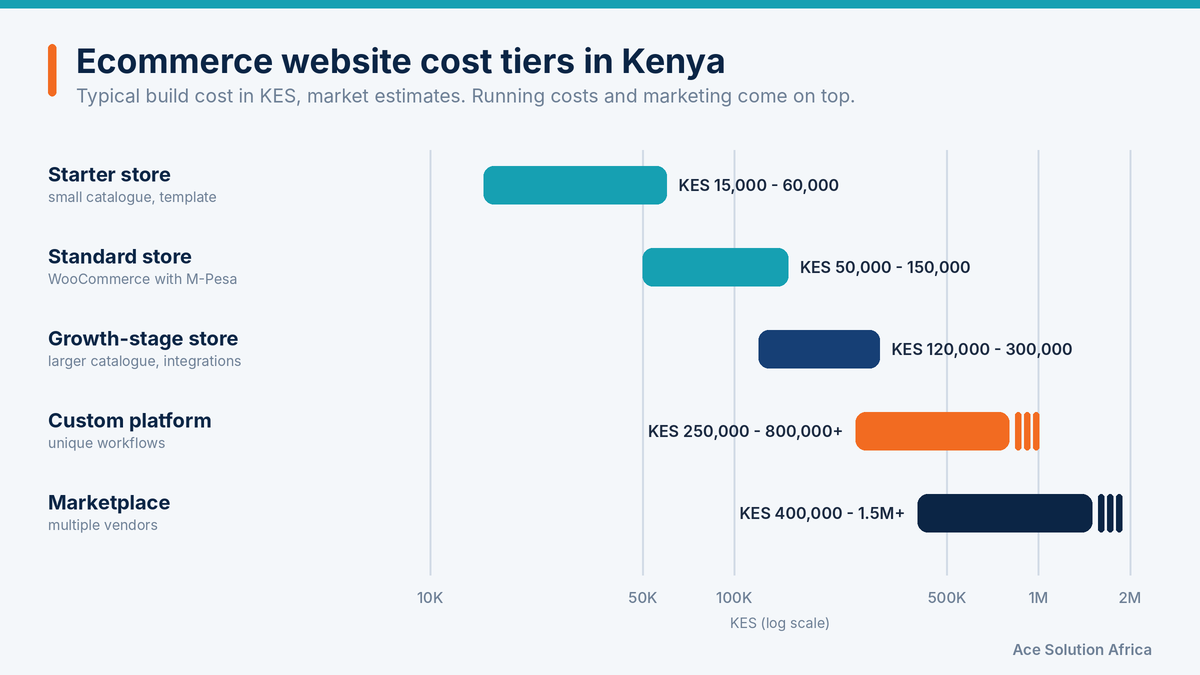
Here is a broad overview of what online store projects commonly cost in Kenya for the development itself.
| Type of store | Typical build cost (KES) | Description |
|---|---|---|
| Starter store on a hosted builder or basic template | 15,000 to 60,000 | Small catalogue, simple design, basic checkout |
| Standard WooCommerce store with M-Pesa | 50,000 to 150,000 | Customised design, product management, M-Pesa and card payments, basic SEO |
| Advanced WooCommerce or Shopify store | 120,000 to 300,000 | Extensive catalogue, custom design, integrations, advanced features |
| Custom-built ecommerce platform | 250,000 to 800,000+ | Unique workflows, deep integrations, high scalability |
| Marketplace or multi-vendor platform | 400,000 to 1,500,000+ | Multiple sellers, commissions, vendor dashboards, advanced logistics |
Ongoing costs such as hosting, domain, maintenance, payment fees and marketing come on top, and we will cover them in detail below.
If you want a sense of how a professional agency scopes this kind of work, you can read about our approach to website design in Kenya, which covers the discovery, design, build and launch stages that also apply to online stores.
Why ecommerce costs more than a normal website
A standard business website is largely informational. An online store has to do much more:
- Display and organise products, categories, variations and prices
- Handle shopping carts, discounts, taxes and shipping options
- Process payments securely, including M-Pesa, cards and possibly bank transfers
- Manage inventory and stock levels
- Send order confirmations, invoices and notifications
- Track orders and deliveries
- Allow customer accounts, wishlists and reviews
- Integrate with accounting, courier and marketing tools
- Protect customer data and payment information
Each of these functions requires design, development, configuration and testing. Mistakes in an ecommerce site cost real money: wrong prices, failed payments, overselling out-of-stock items or security breaches. That is why proper ecommerce development takes more time and care than a brochure site.
The main cost components
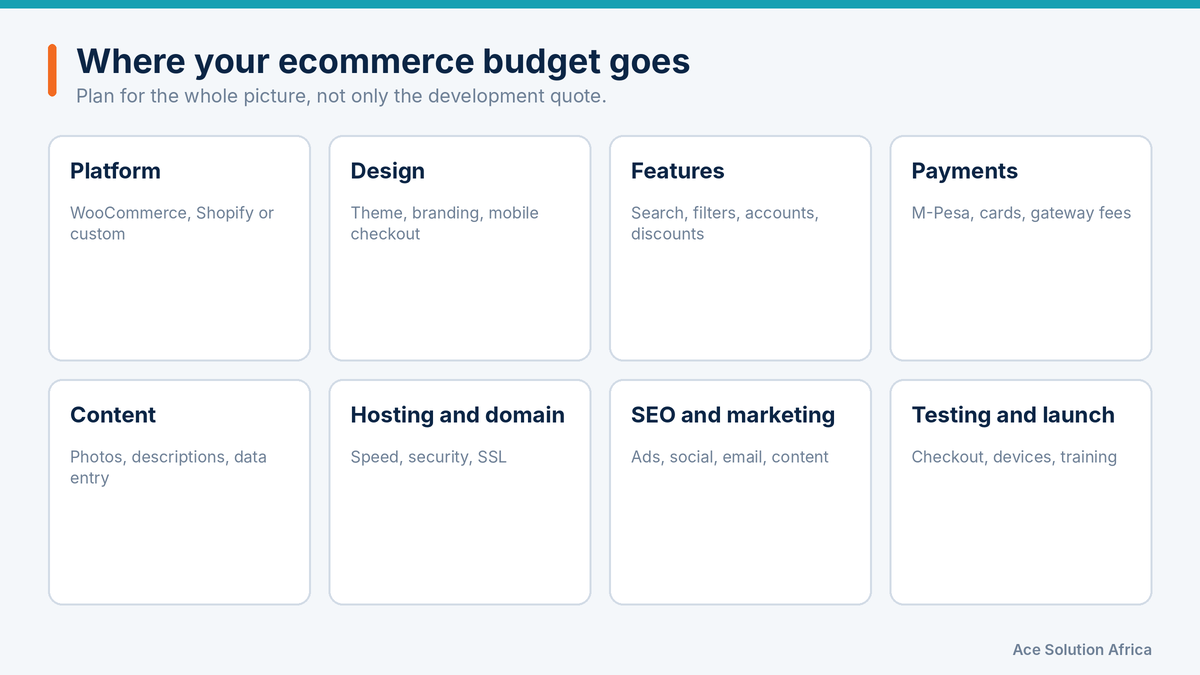
1. Platform choice
The platform you build on is the biggest decision affecting both initial and long-term cost. The popular options in Kenya are:
WooCommerce (on WordPress). An open-source ecommerce plugin for WordPress. There is no licence fee for the core plugin, and there is a huge ecosystem of themes and extensions, including M-Pesa payment plugins. It offers excellent flexibility and ownership but requires hosting, maintenance and technical management. It is often the best value for small and medium stores.
Shopify. A hosted platform with monthly subscription plans. Setup is quick, hosting and security are handled for you, and the dashboard is user-friendly. Costs include monthly plans, paid apps and transaction fees on some setups. M-Pesa integration usually needs a third-party app or payment gateway. It can be excellent for businesses that value convenience and have international ambitions, but the recurring costs add up over time.
Other hosted or local builders. Several local and regional online store builders offer low-cost plans with M-Pesa built in, often bundled with hosting and a domain. They can be a good starting point for very small sellers, though customisation and long-term flexibility may be limited.
Custom-built platforms. Built from scratch using frameworks such as Laravel, Node.js or Django. These offer maximum flexibility and no platform subscription, but higher development cost, longer timelines and the need for ongoing developer support. They make sense for complex requirements such as marketplaces, special pricing logic, subscription services or heavy integrations.
For more on how to decide between a CMS and custom code, see our guide to WordPress versus custom website development in Kenya.
2. Design
Design influences both cost and sales. Options include:
- Pre-made theme with minimal changes. The cheapest approach. Suitable for tight budgets, but your store may look similar to others.
- Customised premium theme. A well-chosen theme adapted to your brand, with improved layouts and user experience. Often the best balance of cost and quality.
- Fully custom design. Designed from scratch to your brand and conversion strategy. More expensive, but can create a distinctive experience.
Good ecommerce design is not just about looking attractive. It focuses on easy navigation, clear product pages, trust signals, fast loading on mobile and a frictionless checkout. Small improvements in these areas can noticeably increase conversion rates.
3. Development and features
Core features are usually included in standard builds, but extras add cost. Common features and their impact include:
- Product catalogue and categories: Basic. More complex when you have thousands of products or many variations.
- Search and filtering: Advanced search, filters by size, colour, price and brand improve usability but add work.
- Customer accounts: Order history, saved addresses and wishlists.
- Discount codes and promotions: Coupons, bundles, flash sales and loyalty programmes.
- Reviews and ratings: Build trust and social proof.
- Multi-currency and multi-language: Needed for international customers.
- Delivery and shipping rules: Zones, couriers, pickup points and delivery fees across Nairobi, other counties or internationally.
- Inventory management: Stock tracking, low stock alerts and multiple warehouses.
- Integrations: Accounting software, ERP or POS systems, CRM, email marketing, courier APIs and WhatsApp.
- Subscriptions or recurring payments: Useful for consumables and services.
- Multi-vendor functionality: Allows many sellers on one platform and increases complexity significantly.
Every extra feature has a cost in design, development and testing, and may carry ongoing licence fees.
4. Payment integration
For Kenyan ecommerce, payment integration is essential and deserves its own budget line.
M-Pesa. Customers expect to pay through M-Pesa, and most successful Kenyan stores offer it. Integration is commonly done through Safaricom’s Daraja API using STK Push, which prompts the customer on their phone to enter their PIN, or through payment aggregators that bundle M-Pesa with other methods. A standard integration by a competent developer is often priced in the range of a few tens of thousands of shillings, depending on complexity, reconciliation needs and whether it is bundled in the overall project. Safaricom does not charge for using the Daraja developer platform itself, but standard M-Pesa transaction charges apply on collections. We explain the process in our article on integrating M-Pesa into your business website.
Cards and other methods. Card payments, Airtel Money, bank transfers and wallets typically require a payment gateway or aggregator. These providers commonly charge a per-transaction fee, and some have setup or monthly fees.
Compliance and verification. Going live with payment providers usually requires business documents and verification steps, which can take time. Factor this into your launch timeline.
5. Content and product data entry
Products do not upload themselves. You need:
- Product photos, ideally consistent in style and size
- Product titles, descriptions, specifications and prices
- Categories and attributes
- Size guides, FAQs and policies
If you have hundreds or thousands of products, data entry or importing can be a significant cost. Some agencies charge for bulk uploads, and professional product photography adds to the budget but often pays for itself in higher conversions. Quality content also helps SEO.
6. Hosting and domain
Ecommerce stores need reliable hosting because downtime directly means lost sales, and security is critical when handling customer information and payments.
- Domain name: A .co.ke or .com domain typically costs from a few hundred to a few thousand shillings per year, depending on promotions and registrar.
- Hosting: Shared hosting can be enough for small stores starting out, and prices can range from a couple of thousand shillings per year to roughly KES 15,000 or more. Growing stores should consider VPS, cloud or managed ecommerce hosting, which can cost considerably more but provides better speed and security.
- SSL certificate: Essential for secure payments. Many hosts include a free certificate.
- Content delivery network (CDN) and caching: Improve speed for visitors across regions, sometimes free and sometimes paid.
Do not choose hosting on price alone. Slow, unreliable hosting damages conversion rates and search performance.
7. SEO and marketing setup
An online store without traffic is an empty shop. Basic SEO setup should be part of your build, including optimised page titles and descriptions, clean URLs, image optimisation, sitemaps, schema markup for products and analytics. Beyond launch, budget for ongoing marketing: content, Google Shopping or search ads, social media advertising, email campaigns, influencer partnerships and Google Business Profile management.
A common mistake is spending the entire budget on building the store and nothing on attracting customers. Many experienced practitioners suggest planning a marketing budget alongside, or even comparable to, the development cost for the first few months.
8. Testing, launch and training
Professional agencies test the store thoroughly: browsers, devices, checkout flows, payment scenarios, shipping calculations, email notifications and security. They also train your team to manage products and orders. This work is part of the quality you pay for, and skipping it leads to expensive problems after launch.
Platform cost comparison: WooCommerce vs Shopify vs custom
To make this practical, consider approximate cost profiles for a small to mid-sized store over three years. The figures below are illustrative planning examples, not quotations.
| Cost element | WooCommerce | Shopify | Custom build |
|---|---|---|---|
| Initial development | KES 50,000 to 150,000 | KES 40,000 to 150,000 | KES 250,000 to 800,000+ |
| Platform fees | None for core plugin; some paid extensions | Monthly subscription, often several thousand KES per month | None |
| Hosting | Your responsibility, KES 5,000 to 60,000+ per year | Included | Your responsibility, varies widely |
| Transaction fees | Payment gateway fees only | Payment gateway fees, plus possible platform transaction fees depending on setup | Payment gateway fees only |
| M-Pesa integration | Plugin or custom, one-off or modest annual cost | Third-party app or gateway, often with monthly cost | Built to specification |
| Maintenance | Required, monthly or annual | Lower technical burden, but apps need management | Required, developer support |
| Flexibility | High | Moderate | Very high |
| Ownership and portability | High | Limited | High if code is handed over |
Some agencies publish three-year comparisons showing that WooCommerce often has the lowest overall cost for small and mid-sized Kenyan stores, Shopify becomes more expensive as plans, apps and fees accumulate, and custom builds pay off mainly when specialised functionality is essential. Your actual numbers will vary, so ask providers to model costs for your particular situation.
Want costs modelled for your own store?
Send us your product count, payment needs and goals, and we will outline a phased plan with real numbers.
Cost by store size and ambition
The small starter store (KES 15,000 to 60,000)
Suitable for a home-based seller, a small boutique or someone testing the market. Typically includes a pre-made template, a limited number of products, basic checkout with M-Pesa through a plugin or local builder, and basic setup. Limitations include less customisation and less sophisticated SEO and integrations. This tier works if your catalogue is small and you are comfortable growing in stages.
The standard small business store (KES 50,000 to 150,000)
The most common category. Includes a customised design, mobile optimisation, a reasonable number of products, M-Pesa and card payments, shipping rules, basic SEO, analytics and training. This is often the sweet spot for established retailers moving online.
The growth-stage store (KES 120,000 to 300,000)
For businesses with larger catalogues, more advanced design, loyalty features, multiple delivery options, integrations with accounting or inventory systems and stronger performance and SEO work. Suited to brands that see ecommerce as a core sales channel.
The custom or marketplace build (KES 250,000 to over 1,000,000)
For businesses with unique requirements: multi-vendor marketplaces, subscription platforms, B2B portals with customer-specific pricing, complex logistics or deep integrations. These are software projects with longer timelines, project management and ongoing development.
The hidden and ongoing costs
Many first-time store owners are surprised by the costs that follow the launch. Plan for these from day one.
Domain and hosting renewals. Every year. Renewal prices can be higher than first-year promotions.
Maintenance and security. Updates, backups, monitoring and fixes. Monthly maintenance plans from agencies can range from a few thousand shillings for basic care to higher amounts for active support. Ecommerce stores need more careful maintenance than simple sites because of payment and customer data.
Plugin, theme and app licences. Premium extensions often renew annually. On Shopify, apps typically bill monthly.
Payment fees. M-Pesa charges, card processing fees and gateway fees reduce your margin on each sale. Include them in your pricing model.
Transaction and platform fees. Depending on the platform, you may pay additional fees on sales.
Delivery and logistics. Courier costs, packaging, returns and insurance are operational expenses that affect profitability, though not part of the website cost itself.
Marketing. Ads, content creation, influencer collaborations, email tools and SEO support.
Photography and content. Ongoing product photography for new stock and seasonal campaigns.
Customer support tools. Live chat, WhatsApp business tools or helpdesk software.
Accounting and tax compliance. Many Kenyan businesses need their sales systems to align with tax and invoicing requirements. Discuss with your accountant how online sales will be recorded and whether integrations with invoicing and tax systems are required.
Upgrades and improvements. Successful stores continuously improve: new features, redesigns, speed optimisations and conversion experiments.
A useful rule of thumb is to budget for the build, the first year of running costs and an initial marketing push as a single plan, rather than treating the build as the whole investment.
A sample first-year budget
Imagine a Nairobi-based fashion retailer launching a standard WooCommerce store with around 150 products, M-Pesa and card payments, and basic SEO. A realistic first-year picture might look like this (illustrative ranges only):
| Item | Approximate range (KES) |
|---|---|
| Store design and development | 80,000 to 150,000 |
| M-Pesa and payment gateway setup | 10,000 to 40,000 |
| Product photography | 20,000 to 80,000 |
| Product data entry and copywriting | 10,000 to 50,000 |
| Domain and hosting | 8,000 to 40,000 |
| Maintenance and security | 36,000 to 120,000 |
| Premium plugins and licences | 5,000 to 40,000 |
| Launch marketing and ads | 50,000 to 300,000 |
Total first-year investment could therefore range from roughly KES 220,000 to well over KES 800,000, depending on choices and ambition. Smaller operations can do far less; larger brands will do more. The point is to see the full picture rather than only the development quote.
How M-Pesa affects your ecommerce budget
Because M-Pesa is so central to Kenyan online payments, it is worth understanding what it adds to cost and effort.
Direct Daraja integration. Involves registering on Safaricom’s developer portal, obtaining credentials, building and testing STK Push in the sandbox environment, handling callbacks that confirm payment, and applying for production access with a valid Paybill or Till number issued by Safaricom. Skilled developers can complete a standard integration in days to a couple of weeks, though approvals and testing can extend the timeline. You pay the developer’s time, not Safaricom for the API itself.
Aggregator or gateway. Third-party providers bundle M-Pesa with cards and other methods, and handle much of the technical and compliance work. They typically charge transaction fees, so they can be simpler to launch but may cost more per sale over time.
Plugins. WooCommerce has several M-Pesa plugins. Quality varies, so choose actively maintained solutions, check reviews and have a developer configure and test them properly.
Reconciliation. If you handle many orders, you will want automatic matching between M-Pesa payments and orders, plus reports for your accountant. This may require extra development but saves large amounts of time.
Security. Credentials and callback endpoints must be protected. Poor handling can lead to fraudulent or duplicate transactions.
For a step-by-step explanation, read our guide on how to integrate M-Pesa into your business website.
Launch an online store with M-Pesa built in
We build fast, secure stores with M-Pesa and card checkout, tested thoroughly before go-live.
What drives your quote up or down
When two ecommerce quotes differ significantly, the reasons usually include:
- Number of products and variations. A store with 20 products is a different project from one with 5,000 SKUs.
- Design depth. Template customisation versus custom design.
- Custom functionality. Unique features not available in standard plugins.
- Integrations. Connecting to inventory, accounting, ERP, courier systems or POS.
- Content work. Who does photography, writing and data entry.
- Performance and security requirements. High-traffic stores need stronger infrastructure.
- Multi-language and multi-currency needs.
- Timeline. Rush projects cost more.
- Provider experience. Senior teams with proven ecommerce track records command higher rates but reduce risk.
- Support and maintenance included. Some quotes include months of support, others do not.
Always compare quotes line by line rather than by the total only.
Ways to control costs without hurting quality
You can keep your budget under control without compromising what matters.
Start with a minimum viable store. Launch with core products, essential payment methods and clear delivery options, then add features as sales grow.
Choose proven platforms. WooCommerce and Shopify have large ecosystems that reduce development time compared with building from scratch.
Prepare your content. Having product photos, descriptions and prices ready avoids delays and extra charges.
Limit variations at launch. Complex product options increase setup time. Start simple.
Prioritise features that drive revenue. Fast checkout, mobile optimisation, trust signals and good product pages usually matter more than flashy extras.
Negotiate bundled services. Some agencies offer better rates for combined design, hosting, maintenance and marketing.
Invest in maintenance. Preventive care is cheaper than recovering from a hacked store.
Measure and refine. Use analytics to identify where customers drop off and improve those areas first.
Mistakes that make ecommerce projects expensive
Choosing on price alone. Very cheap builds often lack security, performance and support, leading to costly rebuilds.
Underestimating content work. Product photography and descriptions can be a major workload.
Ignoring mobile. If your checkout is clumsy on phones, you will lose a large share of buyers.
Overbuilding at the start. Spending heavily on features nobody uses delays launch and burns cash.
Forgetting logistics. A beautiful store without a reliable delivery process damages your reputation.
Skipping testing. Failed payments, wrong totals or broken emails destroy trust.
Not planning marketing. Traffic does not arrive on its own.
Ignoring ownership. Make sure you own your domain, content, customer data and store files, and that you can move providers if needed.
Neglecting legal basics. Display clear terms, pricing, return policy, privacy policy and business contact details, and handle customer data responsibly under applicable Kenyan law. Consult a professional for your specific obligations.
Questions to ask an ecommerce developer
Before you sign, ask:
- Which platform do you recommend for my business, and why?
- What exactly is included in the price: design, products, payments, SEO, training?
- How will M-Pesa be integrated, and are testing and go-live support included?
- What are the ongoing costs for hosting, licences, maintenance and payment fees?
- How will you handle security, backups and updates?
- Can you show me ecommerce stores you have built and put me in touch with those clients?
- How will the store perform on mobile and slow connections?
- Who owns the code, domain, hosting account and customer data?
- What support do I receive after launch?
- How long will the project take, and what do you need from me?
Clear, confident answers indicate an experienced provider.
Timeline expectations
Ecommerce projects usually take longer than simple websites. As a rough guide:
- Starter store: one to three weeks, subject to content readiness.
- Standard store: four to eight weeks, including design, development, product loading and testing.
- Advanced store: two to four months, depending on integrations and features.
- Custom platform or marketplace: four to six months or more.
Payment provider approvals and Safaricom production access can add time, so start those processes early.
Is it worth it?
Whether ecommerce pays off depends on your products, margins, competition and execution. But the trend is clear: Kenyan consumers are increasingly comfortable buying online, and mobile money makes paying simple. A well-built store extends your reach beyond your location, lets you sell around the clock, collects valuable customer data and creates a scalable sales channel.
Think about breakeven. If your average order brings a profit of KES 1,000, then a build and first-year running cost of KES 300,000 requires 300 profitable orders to recover. If your marketing and product-market fit can deliver that within the year, the investment is sound. Run the numbers for your own business, and be realistic about conversion rates and marketing costs.
Choosing the right partner
The right development partner will:
- Ask about your products, customers, logistics and goals before quoting
- Recommend a platform that fits your needs, not just their habits
- Provide an itemised quotation with clear inclusions and exclusions
- Demonstrate experience with Kenyan payment methods and delivery realities
- Build for mobile speed, security and SEO
- Offer training, maintenance and growth support
- Be transparent about ownership and ongoing costs
If you would like help scoping your online store, you can learn more about how we work on our page for website design in Kenya. We can discuss your catalogue, payments, delivery model and budget, and recommend a practical, phased plan.
Frequently asked questions
What is the cheapest way to start selling online in Kenya?
Very basic options include local online store builders with bundled hosting, domain and M-Pesa for low annual fees, or simple WooCommerce setups using a pre-made theme. These suit small catalogues and tight budgets, though you may outgrow them.
How much does it cost to add M-Pesa to my website?
Costs depend on the method. Plugins and aggregators can be relatively inexpensive to set up, while custom Daraja integrations with reconciliation features cost more. Typical professional integration fees are often in the tens of thousands of shillings, and Safaricom does not charge for the Daraja platform itself, though transaction fees apply.
Is Shopify or WooCommerce better in Kenya?
WooCommerce often offers better value and flexibility for local payments and ownership, while Shopify offers convenience and managed hosting at a recurring cost. The right choice depends on your technical comfort, budget, growth plans and need for specific integrations.
Do I need a business registration to accept M-Pesa online?
Production M-Pesa integration generally requires a valid Safaricom-issued Paybill or Till number linked to a registered business or eligible account. Requirements can change, so confirm current rules with Safaricom or your provider.
How long does it take to launch an online store?
Simple stores can launch in a couple of weeks, standard stores in one to two months and complex platforms in several months. Product data, photography and payment approvals are common bottlenecks.
Can I upgrade my store later?
Yes. Starting with a solid foundation and scaling features over time is a common, sensible approach. Ensure your platform and agreement allow for expansion and data portability.
How much should I budget for maintenance?
Plan for ongoing security updates, backups, performance monitoring and support. Many stores budget monthly maintenance, with cost depending on traffic, complexity and level of service.
Will my store appear on Google automatically?
No. Proper SEO setup and ongoing content and marketing are needed. Submitting your site to Google Search Console, optimising product pages and building quality links all help.
Final thoughts
The real cost of an ecommerce website in Kenya is not a single number. It is the sum of the build, the platform, payment integration, content, hosting, security, marketing and ongoing improvement. Starting with a clear scope, choosing the right platform and partner, and planning for the whole first year will help you avoid nasty surprises and get a store that actually sells.
Take your time, compare itemised quotes, ask the hard questions and prioritise what drives revenue: a fast, trustworthy, mobile-friendly store with smooth M-Pesa checkout and a plan to attract customers.
Ready to plan your online store? Explore our website design and development services in Kenya and get in touch with your goals and budget. We will help you map out a realistic path from idea to first sale.
Ready to start selling online?
Let us map out a store that fits your catalogue, your customers and your budget.
Related Posts


Why Your Business Needs a Professional Website
November 23, 2026
How to Choose the Best Website Designers in Kenya
November 23, 2026
LET'S BUILD SOMETHING GREAT
Ready for a better website?
Get a modern website designed around your business, goals, and budget.
Ready to Get Started?
Let's Build a Website That Works for Your Business
Whether you need a professional business website, an ecommerce store, a corporate website, or a complete digital growth strategy, our experienced team is ready to help you achieve your business goals online.
💼
View Our Recent Projects
Explore websites we've designed for businesses across different industries and discover what's possible.
View Projects📞
Book a Free Discovery Call
Speak with one of our website consultants, ask questions, and get expert guidance before making your decision.
Book a Free Call