

Table of contents
Sooner or later, every business planning a new website in Kenya runs into the same question: should we build it on WordPress, or should we have it custom developed from scratch?
On one side you hear that WordPress is affordable, flexible and used by a huge portion of the web. On the other, you hear that custom development is the “serious” option, tailored to your exact needs, more secure and more scalable. Both claims contain some truth, and both can mislead if taken out of context.
The honest answer is that neither approach is universally better. They solve different problems. WordPress is often the smartest choice for a large share of Kenyan businesses, while custom development is the right choice for others. The skill lies in knowing which situation you are in.
This guide explains both approaches in plain language, compares them on the factors that matter to Kenyan business owners (cost, time, security, performance, scalability, M-Pesa integration, maintenance and ownership), and gives you a practical framework for deciding. You do not need any technical background to follow it.
First, what do we actually mean?
What is WordPress?
WordPress is a free, open-source content management system (CMS). A CMS is software that lets you create, edit and organise website content without writing code for every change. You log in to an admin dashboard, add a page or blog post using an editor, upload images, and publish.
WordPress is extended through themes, which control the design and layout, and plugins, which add features such as contact forms, SEO tools, online stores, booking systems, security tools and much more. Because it is open source and widely used, there is a vast ecosystem of themes, plugins, developers and learning resources around it.
When a company says it will “build your website on WordPress,” it usually means they will install WordPress on a hosting server, choose or customise a theme, configure plugins, build your pages and set up the site so you can manage it yourself. A skilled developer can also write custom themes and plugins within WordPress, which blurs the line with custom development, as we will see later.
What is custom website development?
Custom website development means building the website, or web application, from the ground up using programming languages and frameworks, rather than starting from a ready-made CMS. Typical technologies include PHP frameworks such as Laravel, JavaScript frameworks and runtimes such as React, Vue and Node.js, and Python frameworks such as Django, together with databases such as MySQL or PostgreSQL.
The developers design the database, the logic, the user interface and the admin tools specifically for your requirements. Nothing is included unless it is needed, and anything you need can be built, within the limits of budget and time.
Custom development is common for systems such as booking platforms, marketplaces, portals, fintech tools, school management systems, logistics and fleet platforms, and software-as-a-service products.
The key difference in one sentence
WordPress gives you a strong, proven foundation with many features already built, which you assemble and adapt. Custom development gives you a blank canvas where every feature is built to order. The first is faster and usually cheaper to start with. The second offers more control and uniqueness but takes more time and money.
If you want a general picture of how projects like these are scoped and delivered, you can see how an agency typically approaches website design in Kenya, including how platform choices fit into the process.
Comparing WordPress and custom development on what matters
1. Cost
WordPress. Because the core software is free and themes and plugins already provide many features, the build cost is lower. Simple business sites often fall in the tens of thousands of Kenya shillings, and more advanced WordPress projects, such as ecommerce stores or membership sites, may reach into the low hundreds of thousands. Some premium themes and plugins charge annual licence fees, but these are typically modest compared with building the same features from scratch.
Custom. Every feature is designed, built and tested by developers, which takes time. Costs usually start higher and rise sharply with complexity. A custom web application can range from several hundred thousand shillings to well over a million or more, depending on scope, integrations and the team involved. You are paying for engineering hours, not licences.
Long-term view. WordPress is usually cheaper to start and to maintain, but cheap builds with too many poorly chosen plugins can lead to costly clean-ups. Custom systems cost more up front, but if your business model depends on a unique digital process, the investment may be justified because you are building a business asset, not just a brochure.
2. Speed to launch
WordPress sites can often be launched in a matter of weeks. Themes, page builders and plugins accelerate design and development. Content is typically the bottleneck, not the technology.
Custom projects usually take months. Requirements need to be gathered, the architecture planned, features built, tested and refined. If you need to launch quickly to meet a campaign, season or investor deadline, WordPress has a clear advantage.
3. Flexibility and uniqueness
WordPress is more flexible than many people realise. With the right developer, it can handle membership sites, learning platforms, directories, multi-language sites and ecommerce, and it can be heavily customised.
However, you are working within WordPress’s structure. Highly unusual workflows, complex data relationships, specialised calculations or heavy real-time features can become awkward or fragile when forced into a CMS with layers of plugins.
Custom development offers near-total freedom. If your business logic is unique, such as a pricing engine with many variables, a specialised booking system or a multi-role platform with complex permissions, building it custom ensures that the software fits your process rather than the other way around.
4. Ease of content management
For everyday content editing, WordPress is hard to beat. Marketing staff can add blog posts, update services, change images and manage pages without developer help. Many people already know how to use it, which reduces training time.
Custom systems can have excellent admin panels, but those panels are only as good as the developers made them. If the content management side was not carefully built, every small change may require a developer, increasing long-term costs. When commissioning custom work, insist that content editing and admin usability are treated as core requirements.
5. Security
Security is where myths abound, so let us be precise.
WordPress is a popular target for attackers because it is so widely used. Most WordPress security problems, however, arise from avoidable causes: outdated core software, abandoned or poorly coded plugins, nulled (pirated) themes and plugins, weak passwords, inadequate hosting and no backups. A WordPress site that is properly set up, regularly updated, protected with a firewall, backed up and hosted on a reputable server can be very secure.
Custom code is not automatically secure. A custom system written by inexperienced developers can contain serious vulnerabilities such as injection flaws, poor authentication and exposed endpoints. The advantage of custom development is a smaller, more controlled attack surface when professionally built, since you are not running dozens of third-party plugins. But the quality depends entirely on the developers’ skill, coding standards, testing and ongoing maintenance.
In short, neither approach is secure by default. Security comes from competent implementation and continued maintenance. Whichever route you choose, ask about backups, updates, access control, monitoring and incident response.
6. Performance and speed
Page speed affects user experience and search visibility, and in Kenya it matters especially because many visitors use mobile data and mid-range phones.
WordPress can be fast if built well, with a lightweight theme, optimised images, caching, a quality host and a restrained number of plugins. It can also be painfully slow if loaded with a heavy page builder, bloated plugins and cheap hosting.
Custom sites can be extremely fast because they contain only what is needed, but a poorly engineered custom site can be slow too. Again, performance depends on how the site is built, not just the platform.
7. SEO capabilities
WordPress has a strong reputation for SEO-friendliness. Clean URL structures, easy control over titles and meta descriptions, XML sitemaps, schema markup and a wide range of SEO plugins make it simple to implement best practices. Content marketing through blogging fits naturally into the platform.
Custom websites can be fully SEO-friendly too, but SEO features have to be deliberately built: editable meta tags, canonical tags, sitemaps, structured data, redirects and so on. If these are omitted, you may find it difficult and costly to add them later. If search traffic matters to your business, check that the custom plan explicitly includes them.
8. Scalability
Scalability means how well the site copes with growth, in traffic, data or functionality.
WordPress powers everything from small blogs to very high-traffic publications, so it can scale with the right infrastructure, such as caching, content delivery networks, optimised databases and strong hosting. For most Kenyan businesses, WordPress will not be the limiting factor.
Where WordPress can struggle is with highly complex applications involving heavy transactions, intricate data processing or large numbers of simultaneous users performing complicated tasks. In those cases, a purpose-built architecture is usually more sustainable.
9. Integrations, including M-Pesa
Integration with other systems, such as payment providers, accounting software, CRMs, inventory systems and messaging tools, is increasingly important.
For Kenyan businesses, M-Pesa is a top priority. WordPress and WooCommerce offer M-Pesa plugins and gateway integrations that make it relatively quick to accept mobile payments, usually via Safaricom’s Daraja API either directly or through a payment aggregator. This approach is often cost-effective for standard stores and services, but plugin quality varies, so choose well-maintained solutions and test thoroughly.
Custom development allows tightly tailored payment flows, such as automatic reconciliation with your accounting system, complex pricing rules, split payments or detailed transaction dashboards. If your payments are central to your business model, custom integration can offer greater control.
Our article on how to integrate M-Pesa into your business website covers the options in more detail.
10. Maintenance and ongoing costs
WordPress requires regular maintenance: updating the core, themes and plugins, monitoring security, managing backups and checking performance. Many agencies offer maintenance plans for this. The benefit is that a large community and many developers can support WordPress, so you are rarely stuck.
Custom systems also need maintenance: server updates, dependency updates, bug fixes, security patches and feature improvements. Because the code is unique, support often depends on the original developers or on another team that must first learn the codebase. Documentation and clean code are crucial.
11. Ownership and vendor lock-in
WordPress is open source, and files and databases can be moved between hosts and agencies. This gives you considerable freedom. You can change agencies without losing your website, as long as you have proper access and ownership of the domain, hosting and content.
Custom projects can be equally portable if the developers hand over the source code, documentation and deployment details, and if the technology stack is mainstream. Problems arise when code is held back, undocumented or written in an obscure way that few developers can maintain. Always clarify code ownership and handover terms in the contract.
12. Talent availability
Kenya has a deep pool of WordPress developers and designers, which makes it easy to find help and keeps rates competitive. There is also a strong community of developers working in Laravel, JavaScript frameworks and Python, though experienced senior engineers capable of architecting robust systems cost more.
Unsure which platform fits your project?
We will review your goals, budget and timeline and recommend WordPress, custom-built WordPress or a full custom build, with reasons.
Pros and cons at a glance
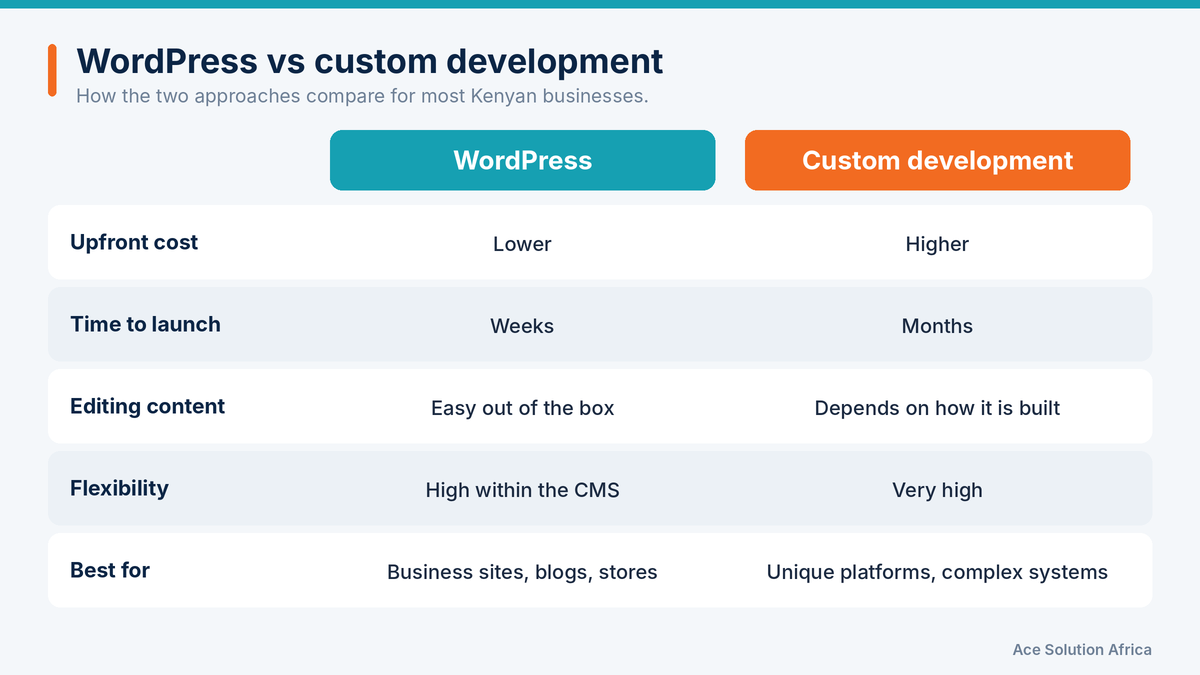
| Factor | WordPress | Custom development |
|---|---|---|
| Upfront cost | Lower | Higher |
| Time to launch | Weeks | Months |
| Flexibility | High within the CMS | Very high |
| Content editing | Excellent out of the box | Depends on how it is built |
| Security | Good with good practice | Good with good engineering |
| Performance | Good if optimised | Excellent if well engineered |
| SEO | Strong tools available | Must be built in |
| Scalability | Good for most sites | Best for complex platforms |
| Maintenance | Routine updates required | Developer support needed |
| Talent pool | Very large | Smaller, more specialised |
| Best for | Business sites, blogs, stores, portfolios | Unique platforms and complex systems |
When WordPress is the right choice
For many Kenyan businesses, WordPress is an excellent fit. Consider it if:
- You need a business, corporate, NGO, school, hospital, hotel, restaurant or portfolio website.
- You want to publish blog content and rank in search engines.
- You need an online store of moderate size using WooCommerce with M-Pesa.
- Your budget is limited and you want quick results.
- Non-technical staff should manage content themselves.
- You want flexibility to change agencies later.
- You plan to add features gradually as the business grows.
Typical examples include a law firm’s website, a safari company’s site with enquiry forms, a school with news and admissions information, a boutique selling clothing online, a real estate agency with property listings or a nonprofit with donation pages.
In these cases, custom development would often add cost and time without providing proportional benefits.
When custom development is the right choice
Custom development makes sense when your project is more like software than a website. Consider it if:
- Your business model depends on a unique digital product or process.
- You need complex workflows, such as multi-step approvals, role-based dashboards or sophisticated pricing logic.
- You are building a marketplace, booking engine, fintech tool, logistics platform or software-as-a-service product.
- You need extensive integrations with internal systems, APIs or specialised hardware.
- You expect large numbers of concurrent users and heavy transactions.
- You have strict compliance or security requirements.
- You have the budget and timeline for a proper software project.
For example, a ride-booking platform, a farm-to-market ordering system, a loan management portal, a fleet tracking dashboard or a school management information system would typically need custom engineering or a specialised software product rather than a plain WordPress site.
Building something more complex than a website?
From booking engines to portals and payment platforms, we build to your exact process. Start with a scoping conversation.
The middle path: custom-built WordPress
The choice is not always binary. A strong third option is custom WordPress development, where experienced developers build a bespoke theme and tailored plugins on top of WordPress rather than relying on a heavy off-the-shelf theme with many third-party plugins.
This approach combines the friendliness of the WordPress admin with a cleaner, faster, more tailored codebase. It is well suited to businesses that want a distinctive design, strong performance and specific features while still benefiting from the CMS’s ecosystem.
Another hybrid option is headless WordPress, where WordPress manages content but a separate custom front end, built in a framework like React or Next.js, displays it. This can provide very fast, highly customised experiences but adds complexity and cost, so it is generally reserved for projects with advanced requirements.
Common mistakes Kenyan businesses make
Choosing custom when WordPress would do
Some businesses assume that custom is always better or more prestigious, and end up paying a premium for features they never use. If your site is essentially informational, the extra cost rarely produces extra results.
Choosing WordPress for something that is really software
Others try to stretch a CMS to support a complex application by stacking many plugins. The result can be slow, fragile and hard to maintain. If you find yourself needing to hack together a dozen plugins for one core function, it may be time to consider a purpose-built solution.
Using nulled themes and plugins
Pirated premium themes and plugins are a notorious source of malware. They also cannot receive proper updates. Always use legitimate licences, even if it costs a little more.
Overloading the site with plugins
Every plugin adds code, potential conflicts and security surface. Use only what is necessary and prefer well-maintained, reputable plugins with active support.
Ignoring hosting quality
Even the best site will struggle on poor hosting. Consider performance, uptime, security features, support and server location, especially when your audience is primarily in Kenya or East Africa.
Skipping maintenance
WordPress sites left untouched for a year are vulnerable. Custom systems left unmaintained accumulate technical debt. Budget for continuous care.
Not clarifying ownership
Whether you choose WordPress or custom, make sure you own the domain, hosting access, code and content.
A simple decision framework
Answer these questions to guide your choice.
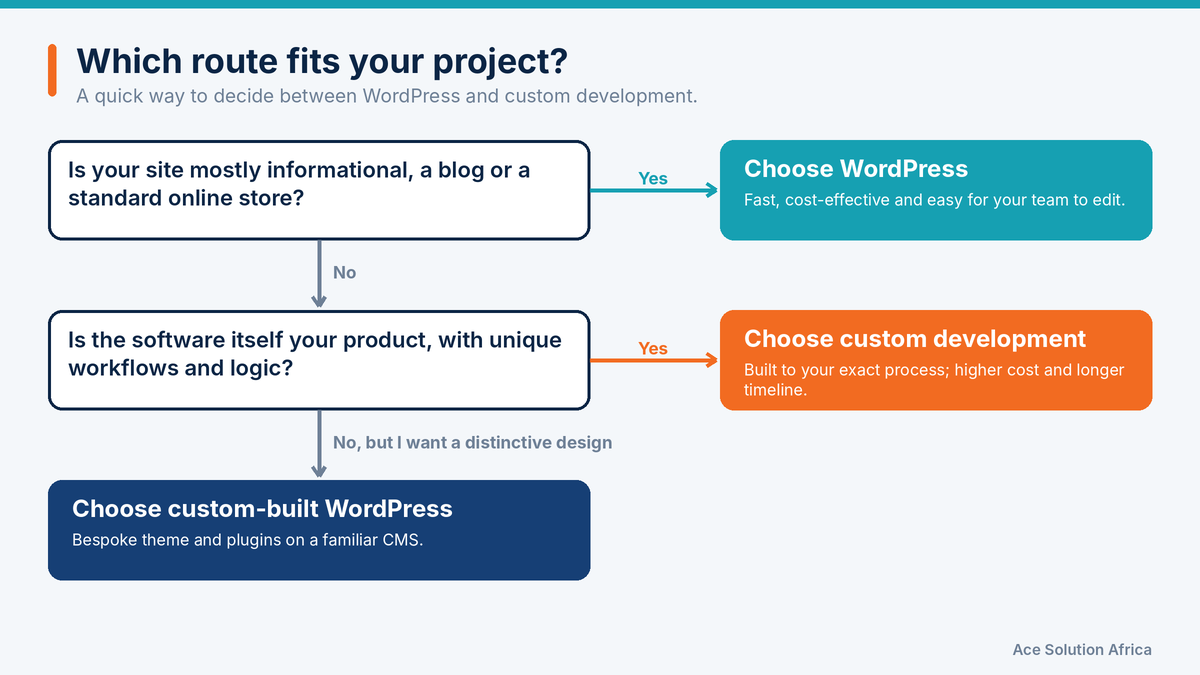
1. What is the core purpose of the site? – Information, leads, credibility or content marketing: lean toward WordPress. – A unique digital product or complex process: lean toward custom.
2. How unique are the features? – Mostly standard features such as forms, galleries, blogs, bookings and basic shop: WordPress. – Unusual business logic that no plugin covers: custom.
3. What is your budget? – Limited to moderate: WordPress. – Substantial, with willingness to invest in a long-term digital asset: custom becomes realistic.
4. How fast do you need to launch? – In weeks: WordPress. – Months are acceptable: custom is feasible.
5. Who will manage the content? – Non-technical staff who need independence: WordPress, or a custom CMS with a very good admin.
6. How much growth do you expect? – Gradual growth in content and traffic: WordPress. – Rapid scaling in transactions and users: plan for custom architecture.
7. How important is flexibility to switch providers? – Very important: WordPress, or custom with clear documentation and code ownership.
If most of your answers point to the first option in each pair, WordPress is probably right. If most point to the second, begin exploring a custom build, ideally with a discovery phase that defines requirements before development starts.
Real-world scenarios
Scenario 1: A Nairobi consultancy. The firm wants a professional website with services, a team page, case studies, a blog and an enquiry form. WordPress with a well-customised theme is ideal. It delivers a polished site quickly and at sensible cost, and the team can publish articles to attract search traffic.
Scenario 2: A Mombasa guesthouse. They need photo galleries, room descriptions, a map, reviews and online enquiries or bookings. WordPress with a booking plugin may suffice, particularly if they connect to a channel manager. If they want complex dynamic pricing across multiple properties, a more specialised system may be required.
Scenario 3: A fashion boutique in Westlands. They want to sell clothing online with M-Pesa and card payments, manage stock and promote seasonal offers. WooCommerce on WordPress is a strong fit. Custom would be considered only if they plan a marketplace or highly unusual features.
Scenario 4: A logistics start-up. They need customer accounts, driver apps, real-time tracking, dynamic pricing, wallet payments and admin dashboards. This is a software product. Custom development, possibly alongside mobile apps, is appropriate.
Scenario 5: A school. They need news, admissions information, downloadable forms and a parent portal with results and fee statements. A WordPress site can handle the public side, and a specialised school management system or custom portal might handle the secure data, integrated through single sign-on or links.
What about website builders like Wix and Shopify?
Hosted builders form a third category. They are convenient for small businesses that want to launch quickly without managing hosting or technical details. The trade-offs are ongoing subscription fees, platform limitations, less control over performance and SEO, and in some cases difficulty exporting your site if you decide to leave. For Kenyan businesses, M-Pesa integration is possible with some platforms, often via third-party apps or gateways, but it may involve extra cost or complexity. They can be a suitable starting point, but many growing businesses eventually prefer the flexibility of WordPress or custom solutions.
Questions to ask your web agency
Whichever route you take, ask:
- Why do you recommend this platform for my project, and what are the alternatives?
- How will my site be updated, backed up and secured?
- Who owns the code and the content, and will I receive full access?
- How do you handle performance on mobile devices and slower connections?
- Is M-Pesa integration included, and which method will you use?
- What are the ongoing costs for hosting, licences and maintenance?
- If I want to switch providers or add features later, what will that involve?
- Can you show examples of similar projects built on this platform?
An honest agency will explain the trade-offs and may even tell you that a simpler or more advanced option fits better than the one you first asked for.
Cost and timeline expectations
Though every project differs, a rough guide can help you plan.
- WordPress business website: commonly several weeks and budgets from tens of thousands to around KES 150,000 or more, depending on pages, design and features.
- WordPress ecommerce with M-Pesa: typically several weeks to a couple of months, with budgets ranging widely from modest to several hundred thousand shillings depending on catalogue size and customisation.
- Custom web application: often three to six months or longer, with budgets that can run from several hundred thousand to well beyond a million shillings depending on scope and team.
Treat these as planning ranges only. A detailed written scope is the only way to arrive at a reliable estimate.
Future-proofing your decision
Whichever option you choose, you can improve your outcome by following a few principles.
- Start with a clear scope. Know what you need now and what can wait.
- Choose mainstream technology. Popular, well-supported tools make it easier to find developers later.
- Insist on documentation. Especially for custom builds, documentation protects your investment.
- Plan for maintenance. Budget monthly or annually for updates and support.
- Keep data portable. Make sure you can export content, customers and orders.
- Use staging environments. Test changes before they go live.
- Measure results. Install analytics and review performance regularly, so you can adapt.
Technology decisions are rarely permanent. Many successful businesses launch on WordPress, grow, and later build custom components or migrate parts of the system when their needs outgrow the original setup. Starting simple is often the more strategic choice than building everything at once.
Final thoughts
The WordPress versus custom debate sounds technical, but it is really a business decision. If your goal is to establish a credible, fast, search-friendly online presence and perhaps sell products with M-Pesa, WordPress will usually deliver the best balance of cost, speed and flexibility. If your goal is to build a unique digital platform where the software itself is the product or the core of your operations, custom development is likely worth the extra investment.
Be wary of anyone who insists that one option is always right. The best agencies recommend based on your goals, budget, timeline and growth plans, and they explain their reasoning in plain language.
If you are weighing these options for your own project, our team can help you assess requirements and recommend a realistic path. You can learn more about our approach to website design in Kenya and reach out to discuss whether WordPress, a custom-built WordPress solution or a fully custom system best fits your business.
Get the right platform from day one
Tell us what your website must do and we will recommend the most cost-effective route to launch.
Related Posts

Ecommerce Website Development Costs in Kenya: A Complete Guide
November 23, 2026
Why Your Business Needs a Professional Website
November 23, 2026
How to Choose the Best Website Designers in Kenya
November 23, 2026
LET'S BUILD SOMETHING GREAT
Ready for a better website?
Get a modern website designed around your business, goals, and budget.
Ready to Get Started?
Let's Build a Website That Works for Your Business
Whether you need a professional business website, an ecommerce store, a corporate website, or a complete digital growth strategy, our experienced team is ready to help you achieve your business goals online.
💼
View Our Recent Projects
Explore websites we've designed for businesses across different industries and discover what's possible.
View Projects📞
Book a Free Discovery Call
Speak with one of our website consultants, ask questions, and get expert guidance before making your decision.
Book a Free Call