

Table of contents
Hiring a web design company is one of those decisions that feels simple until you are in the middle of it. You search online, you find dozens of agencies in Nairobi, Mombasa, Kisumu and beyond, and each one claims to be the best. Their portfolios look polished. Their prices range from impressively cheap to eye-wateringly high. Somebody’s cousin recommends a freelancer who “does websites very well.” Meanwhile you have a business to run.
The stakes are real. Your website is often the first impression a potential customer has of your business, and in many cases it is the only impression that matters before they decide whether to call you, visit you or buy from you. A good website becomes a hardworking salesperson that never sleeps. A bad one becomes an expensive embarrassment, or worse, a security liability.
This guide walks you through ten things to consider before you hire a web design company in Kenya. Each point includes what to look for, which questions to ask and which warning signs to avoid. Use it as a checklist when you are comparing providers, and you will make a far better decision than most businesses do.
1. Be clear about your own goals first
The first thing to consider has nothing to do with the agency. It is you. Before you speak to any web designer, you need to be able to answer a few basic questions:
- What is the main purpose of the website? Is it to generate enquiries, sell products, take bookings, build credibility, recruit staff or share information?
- Who is the target audience? Are they local customers on mobile phones, corporate buyers, tourists, donors, parents or international clients?
- What does success look like? Ten extra enquiries a month? Online sales of a certain value? Fewer phone calls asking basic questions?
- What do you like and dislike about competitors’ websites?
- What is your realistic budget and timeline?
Agencies can only propose the right solution if they understand the problem. If you hand over a vague brief such as “we need a nice website,” you will receive vague proposals and wildly different prices that are impossible to compare.
A helpful exercise is to write a one-page brief. Include your business description, your goals, your target customers, pages you expect, features you need, websites you admire and your budget range. Even a rough brief puts you in a stronger position and helps good agencies respond precisely.
A good web design company will also ask you these questions. If an agency sends you a price without asking about your goals, treat it as a red flag. It means they are selling a package, not solving your problem.
2. Review their portfolio, and look beyond the screenshots
Every agency has a portfolio. The question is how to read it properly.
Look for relevance. Has the company built websites for businesses similar to yours, in similar industries and with similar needs? An agency that has built ten hotel websites understands booking enquiries and imagery. One that has built school websites understands parent communication and admissions. Experience in your sector shortens the learning curve and reduces mistakes.
Open the live sites. Do not rely on pictures in a gallery. Visit the actual websites in the portfolio and test them. Do they load quickly on your phone? Do the menus work? Are the forms functional? Does the design look consistent on a small screen? If portfolio links are broken or redirect to unrelated pages, that tells you something about the agency’s follow-through.
Check the substance, not just the style. A beautiful homepage can hide poor structure. Click through inner pages, try the search, look at the footer, read the text. Is the content clear? Is there an obvious next step for visitors? Good web design is not decoration; it is communication.
Ask about the results. Beyond how a site looks, what did it achieve? A mature agency can talk about increased enquiries, improved search visibility, faster load times or higher conversion rates, even if they cannot share exact numbers because of confidentiality.
Verify that the work is theirs. Sadly, some providers show templates or other people’s work as their own. Ask who worked on specific projects, what their role was and how long the project took. Ask for the story behind a couple of portfolio pieces: the problem, the solution and any challenges. People who genuinely built a site can talk about it in detail.
If you want to see how a structured agency presents its approach, our page on website design in Kenya shows how a project is typically organised from discovery through to launch, which is a helpful reference point when you are evaluating other providers too.
3. Ask for references and real client feedback
Portfolios show the finished product. References show the experience of working with the company. These can be very different.
Ask for contact details for two or three past clients and actually call them. Useful questions include:
- Was the project delivered on time and within the agreed budget?
- How responsive was the team during the project?
- Did the final website match what was promised?
- Were there any surprises or hidden costs?
- How has the agency handled support since launch?
- Would you hire them again?
You can supplement this with online research. Check Google Business Profile reviews, LinkedIn pages, social media and business directories. Look for patterns rather than isolated comments. One angry review does not tell you much, but repeated complaints about missed deadlines, disappearing developers or surprise charges are a signal.
Be careful about testimonials that look too generic or cannot be traced to real people or businesses. A reputable company will happily connect you with a satisfied client.
4. Understand exactly what is included in the price
Price comparisons fall apart when the scope is unclear. Two quotes can look similar on the surface while delivering very different results. Before you compare numbers, compare inclusions.
Ask for a written quotation that specifies:
- Number and type of pages. Which pages are included and what happens if you need more?
- Design approach. Is it a customised template or a design created from scratch? How many rounds of revisions are included?
- Functionality. Contact forms, booking tools, WhatsApp integration, live chat, search, galleries, blog, multilingual support, online payments and so on.
- Content. Who writes the copy and sources images? Is professional photography or copywriting included or extra?
- SEO setup. Titles, meta descriptions, heading structure, image optimisation, sitemap, Google Search Console and Analytics setup.
- Mobile responsiveness. Confirmation that the site will be tested across devices.
- Hosting and domain. Whether they are included, for how long and who owns them.
- Security. SSL certificate, backups, security plugin or firewall and user access controls.
- Training and handover. Whether you will be shown how to edit your site and receive documentation or logins.
- Support period. Free support after launch and what ongoing support costs.
- Taxes. Whether the price includes or excludes VAT.
If you want a deeper look at how pricing works in the market, see our detailed guide to how much website design costs in Kenya. The key point here is that a clear, itemised quotation is a sign of a professional company. A single lump sum with no explanation is a reason to ask more questions.
Also be wary of quotes that are dramatically lower than the others. Extremely low prices often mean hidden extras, pirated themes, rushed work or no support. Equally, a very high price does not automatically mean high quality. You are looking for fair value and transparency.
Compare us against this checklist
We are happy to answer every question in this guide: portfolio, ownership, security, support and pricing, in writing.
5. Confirm that you will own your website, domain and content
Ownership is one of the most overlooked issues in web projects, and one of the most painful when it goes wrong. You should be clear on who owns:
- The domain name. It should be registered in your business name or personal name, with you as the registrant and administrator. Some agencies register domains in their own name “for convenience,” which can later become leverage if you part ways.
- The hosting account. Ideally you have access to it or can request a transfer.
- The website files and database. You should receive a copy or have the right to a full export.
- The design assets. Logos, images and graphics created for you should be yours to use.
- The content. Text, photos and videos you supplied remain yours.
- Licences for premium plugins and themes. Some require annual renewals. Ask who pays and in whose name they are registered.
Ask directly: “If I decide to move to another provider in two years, what happens to my website?” The answer should be straightforward. If the company uses a proprietary system that locks you in, or says you cannot take the site with you, think carefully about whether that arrangement suits you.
Put ownership terms in the contract. Verbal assurances are not enough when relationships change.
6. Check their technical approach and the platform they use
You do not need to become a developer, but it helps to understand the basic choices because they affect your costs, flexibility and future.
WordPress is the most widely used content management system, powering a large share of websites worldwide. It is flexible, has a huge ecosystem of themes and plugins, and makes it easy for non-technical people to update content. For most small and medium-sized businesses in Kenya it is an excellent choice when properly built and maintained.
Hosted platforms such as Shopify, Wix or Squarespace are easy to start with and handle hosting for you, but they involve monthly subscriptions and some limitations in customisation and portability.
Custom development using frameworks such as Laravel, Django, Node.js or others suits complex systems with unique business logic, such as booking engines, portals, marketplaces and integrations. It costs more but offers maximum control.
Questions worth asking:
- Why do you recommend this platform for my project?
- Will I be able to update content myself?
- How will the site handle growth, such as more pages, products or visitors?
- Do you follow coding standards and use a staging environment for testing before changes go live?
- How do you handle updates to themes and plugins?
- What is your approach to site speed and performance?
A trustworthy agency explains the trade-offs in plain language and recommends what fits your needs rather than what is easiest for them. For a closer comparison, read our article on WordPress versus custom website development in Kenya.
7. Make sure they build for mobile, speed and search engines
Many Kenyan internet users browse primarily on smartphones, often on mobile data connections that vary in quality. A website that looks lovely on a designer’s large monitor but loads slowly or breaks on a mid-range Android phone will frustrate visitors and cost you business.
When you evaluate a company, test their approach to three technical fundamentals.
Mobile-first design. Ask how they design and test for mobile. Request to see mockups or staging sites on a phone. Buttons should be easy to tap, text easy to read, and forms easy to complete without zooming or awkward scrolling.
Speed. Ask how they optimise performance. Good answers include image compression and modern formats, caching, a lean codebase, reliable hosting, content delivery networks where appropriate and careful use of plugins. You can test the speed of their portfolio sites using free tools such as Google PageSpeed Insights.
Search engine optimisation. Building a site that search engines can understand is much easier at the start than fixing later. Ask what on-page SEO is included, how they structure URLs, headings and internal links, and whether they set up Google Search Console and Analytics. Be sceptical of anyone who guarantees “number one on Google” in a short time. Search rankings depend on many factors, including competition, content quality and ongoing effort, and no honest provider can promise a position.
A good agency also understands local search. If your business serves a particular area, ask about Google Business Profile optimisation, local keywords and location pages.
8. Ask about security, backups and data protection
Hacked websites are common, and small business sites are frequent targets because they are often poorly protected. A compromised website can display spam, redirect visitors to malicious pages, leak customer data and damage your reputation and search rankings.
Before hiring, ask:
- Do you install an SSL certificate so the site uses https?
- What security measures do you set up, such as firewalls, login protection, limiting login attempts and two-factor authentication?
- How often do you back up the website, where are backups stored and how quickly can you restore them?
- Who handles updates to the core software, themes and plugins?
- What hosting do you use or recommend, and what security features does it include?
- What happens if the site is hacked?
Data protection matters too. If your site collects names, emails, phone numbers or payment information, you have a responsibility to handle that data properly. Kenya’s Data Protection Act sets out obligations for organisations that process personal data, which can include having a privacy policy, collecting only necessary information, securing it appropriately and, for many organisations, registering with the Office of the Data Protection Commissioner. Ask your agency whether they build privacy-conscious forms, cookie notices where relevant and clear consent mechanisms. You should also take your own legal advice for your specific situation, because a web design company is not a substitute for legal counsel.
If you plan to accept online payments, security becomes even more important. Ensure the provider has experience integrating payment systems such as M-Pesa, cards and bank gateways safely. We cover this in our guide on integrating M-Pesa into your business website.
9. Evaluate their process, communication and project management
A great design can still produce a terrible experience if the process is chaotic. The way an agency works day to day will affect your stress levels, your timeline and the final result.
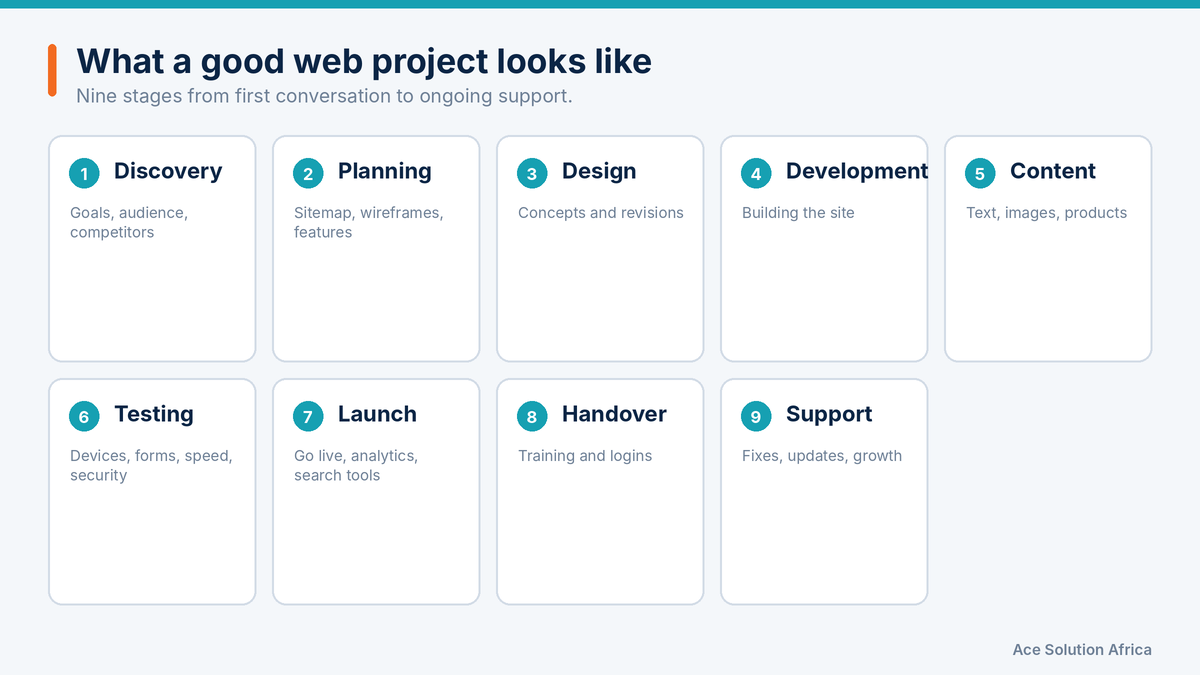
Ask them to walk you through their process. A solid web project typically includes:
- Discovery and briefing. Understanding your business, goals, audience and competitors.
- Planning. Sitemap, wireframes and feature list.
- Design. Visual concepts for key pages, with revision rounds.
- Development. Building the site, installing features and integrating content.
- Content loading. Adding text, images and products.
- Testing. Checking across devices and browsers, forms, links, speed and security.
- Launch. Going live, setting up analytics and search tools and redirecting old pages if relevant.
- Handover and training. Showing you how to manage the site.
- Post-launch support. Fixing issues and offering ongoing care.
Also consider communication:
- Who will be your point of contact?
- How will progress be shared? Weekly updates, a project tool, email, WhatsApp or meetings?
- How quickly do they respond to questions?
- What are the milestones and timelines, and what happens if either side causes delays?
- How are change requests handled and priced?
You can learn a lot from the sales process. If a company is slow to reply, vague in answers or unprofessional before you sign, it rarely improves afterwards. On the other hand, an agency that asks thoughtful questions, gives clear timelines and sets expectations honestly is likely to manage your project well.
Realistic timelines vary. A simple site may take a couple of weeks, a standard business site three to six weeks, and larger projects longer, mostly depending on how quickly you provide content and feedback. Be suspicious of promises like “a full business website in 24 hours” unless it is explicitly a very small template-based project.
10. Look at support, maintenance and the long-term relationship
Launching your website is not the finish line. It is the starting line. Websites require ongoing care, and the quality of post-launch support often separates good agencies from average ones.
Ask about:
- Support period. Is there a free support or warranty period after launch to fix bugs?
- Maintenance plans. What do they include, such as software updates, backups, uptime monitoring, security scans, minor content edits and performance checks? What do they cost?
- Response times. If something breaks, how quickly can you expect help?
- Additional work. How do they price new pages, new features, redesign phases or marketing support?
- Growth services. Do they offer SEO, content writing, Google Ads, social media or email marketing so your site keeps working for you?
- Continuity. If your main contact leaves the company, how do they keep your project and knowledge safe?
A website is a living asset. Plugins need updates, content needs refreshing, offers change and security threats evolve. If you neglect it, performance and security decline. A good agency presents maintenance as protection of your investment, not as an arbitrary add-on.
Consider the agency’s stability too. How long have they been in business? Do they have a physical office, a registered company and visible team members? Longevity is not a guarantee of quality, but businesses that have operated for years usually have processes and reputations to protect.
Looking for a web design partner you can trust?
Transparent pricing, clear ownership and support after launch. See how we approach every project.
Bonus: red flags that should make you pause
Beyond the ten points above, watch out for these warning signs.
- Pressure tactics. “This price is only valid today” or demands for full payment before any work starts.
- No contract. Professional projects have written agreements that define scope, payment terms, ownership and responsibilities.
- Unrealistic guarantees. Promises of instant top rankings, guaranteed sales or unlimited revisions for very low prices.
- Vague or evasive answers. Reluctance to discuss technology, ownership, hosting or support.
- No visible track record. No portfolio, no references and no online presence.
- Pirated software. Use of cracked themes or plugins can lead to malware and legal problems. Ask whether licences are genuine.
- Template cloning. Selling a barely modified copy of another site as a “custom design.”
- Hidden costs. Surprises such as charges for hosting, SSL, plugins or “changes” that were never explained.
- Poor communication. Missed calls, slow responses or inconsistent messages during the sales stage.
Remember that one red flag does not necessarily disqualify a company, but several together are a strong reason to walk away.
A simple scorecard for comparing agencies
When you have two or three candidates, a simple scorecard keeps the decision objective. Rate each agency from 1 to 5 on the following criteria:
| Criteria | Agency A | Agency B | Agency C |
|---|---|---|---|
| Understanding of your goals | |||
| Relevant portfolio and experience | |||
| Quality of references | |||
| Clarity of quotation and scope | |||
| Ownership and contract terms | |||
| Technical approach and platform fit | |||
| Mobile, speed and SEO capability | |||
| Security and backups | |||
| Process and communication | |||
| Support and maintenance | |||
| Value for money |
Add the scores, but also use judgement. The best choice is often the agency you trust most to deliver, not necessarily the one with the highest number on paper.
How to structure a safe payment and contract arrangement
Money and paperwork create most of the disputes in website projects, so it is worth setting them up carefully.
Payment milestones. Instead of paying everything up front or only at the end, split payment into stages. A common pattern is a deposit to begin, a payment when designs are approved and a final payment at or just before launch. This keeps both parties motivated.
Written agreement. A good contract or service agreement should describe the scope of work, deliverables, timeline, payment schedule, revision limits, ownership of the website and content, confidentiality, responsibilities of each party, support terms and how disputes or terminations are handled.
Change management. Requests that go beyond the agreed scope should be documented and priced before work begins, so there are no unpleasant surprises.
Content deadlines. Agree on dates for supplying text, images and feedback. Delays on either side can push the launch date.
Acceptance criteria. Define what “done” means, such as the site passing agreed tests, all agreed pages being live and training being completed.
Keep copies of all communications and approvals. If you are working on a larger project, consider having a lawyer review the agreement.
What you should prepare to make the project smoother
Even the best agency will struggle if the client side is unprepared. You can make the project faster, cheaper and better by arranging a few things in advance.
- Brand assets. High-resolution logo, brand colours, fonts and any style guidelines.
- Content. Draft text for core pages, service descriptions, team bios, testimonials, FAQs and contact details. If you lack time, ask whether the agency offers copywriting.
- Images and video. Good-quality photos of your premises, products, team or projects. Poor photos can undermine even an excellent design.
- Competitor and inspiration list. Sites you like and why.
- Decision-makers. Decide who approves designs and consolidate feedback so the agency receives one clear set of comments.
- Access details. Any existing domain, hosting, email and social media accounts, plus current website logins if you are redesigning.
- Legal documents. Terms and conditions, privacy policy, return and refund policy for ecommerce, and any licences or registrations you wish to display.
Preparation shows respect for the agency’s time and increases the likelihood of delivery on schedule.
Questions to ask in your first meeting
To help you get started, here is a practical list of questions you can bring to your first conversation with any web design company in Kenya.
- How long have you been building websites, and what types of businesses do you usually work with?
- Can you show me three projects similar to mine and put me in touch with those clients?
- Who will work on my project, and who will be my main contact?
- What platform would you recommend for my needs, and why?
- What is included in your price, and what would cost extra?
- How long will the project take, and what do you need from me to keep it on schedule?
- Will I own my domain, website files and content?
- How do you handle mobile design, site speed and SEO?
- What security measures and backups do you provide?
- What happens after launch? What support and maintenance options do you offer?
- How do you structure payments and contracts?
- What would make this project go wrong, and how do you prevent it?
That last question is revealing. Experienced agencies can describe real risks, such as delayed content, unclear decision-making or scope creep, and explain how they manage them.
Local knowledge: why Kenyan context matters
Hiring a company that understands the Kenyan market can make a practical difference. Local agencies are familiar with how Kenyan customers search, browse and pay. They understand the importance of mobile-first experiences, WhatsApp as a communication channel, M-Pesa as a payment method and the role of local search in driving foot traffic and calls.
They are also better placed to handle practical matters such as registering .co.ke domains, working with local payment providers and hosting options, understanding relevant regulations and meeting you in person or in your time zone when needed. That does not mean international providers cannot do excellent work. It simply means that for a business serving Kenyan customers, local insight is an advantage worth weighing.
At the same time, avoid assuming that a Nairobi address automatically guarantees quality. Look at actual capability, process and results.
Putting it all together
Hiring a web design company is ultimately about trust and fit. The right partner will understand your goals, explain choices clearly, deliver a secure, fast and search-friendly website, respect your ownership rights and remain available when you need help.
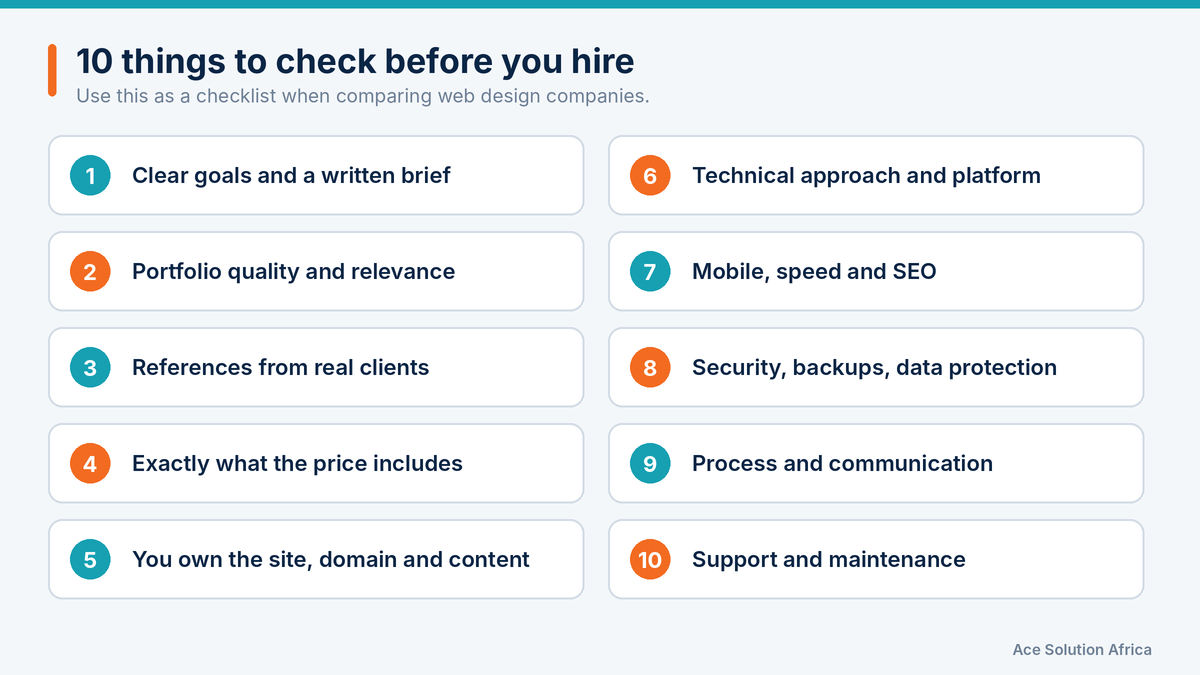
To recap, here are the ten things to consider:
- Be clear about your own goals and brief.
- Review the portfolio carefully, and test live sites.
- Ask for references and read real feedback.
- Understand exactly what is included in the price.
- Confirm ownership of your domain, website and content.
- Check the technical approach and platform choice.
- Make sure they build for mobile, speed and SEO.
- Ask about security, backups and data protection.
- Evaluate their process and communication.
- Look at support, maintenance and long-term partnership.
Take your time, ask questions and insist on clarity in writing. The few extra days you spend choosing wisely can save months of frustration and a significant amount of money.
If you would like to see how a professional agency structures its projects and what a thorough website engagement can include, you are welcome to explore our page on website design in Kenya. When you are ready to discuss your own project, get in touch with your goals, your budget and your timeline, and we can recommend a practical way forward that fits your business.
Let us earn your trust with your first conversation
Bring your brief, your budget and your hardest questions. We will give you honest answers and a clear plan.
Related Posts

Ecommerce Website Development Costs in Kenya: A Complete Guide
November 23, 2026
Why Your Business Needs a Professional Website
November 23, 2026
How to Choose the Best Website Designers in Kenya
November 23, 2026
LET'S BUILD SOMETHING GREAT
Ready for a better website?
Get a modern website designed around your business, goals, and budget.
Ready to Get Started?
Let's Build a Website That Works for Your Business
Whether you need a professional business website, an ecommerce store, a corporate website, or a complete digital growth strategy, our experienced team is ready to help you achieve your business goals online.
💼
View Our Recent Projects
Explore websites we've designed for businesses across different industries and discover what's possible.
View Projects📞
Book a Free Discovery Call
Speak with one of our website consultants, ask questions, and get expert guidance before making your decision.
Book a Free Call