

Table of contents
Search for “website designers in Kenya” and you will be met with an overwhelming list. There are large agencies in Nairobi’s Westlands and Upper Hill, boutique studios in Kilimani, hosting companies that also build sites, freelancers working from Mombasa, Kisumu, Nakuru and Eldoret, and graduates who have just finished their first course in web development. Almost all of them claim to be the best.
How do you separate genuine quality from good marketing? How do you avoid the horror stories, such as the designer who vanished after receiving a deposit, the site that was hacked within months, or the “custom” website that turned out to be a pirated template?
This guide is a practical, step-by-step process for choosing the best website designers for your business in Kenya. It is written for business owners, marketing managers and entrepreneurs who are not technical, so you will not need to read any code. By the end, you will know how to build a shortlist, evaluate candidates, compare proposals fairly and make a confident decision.
If you are earlier in the journey and still wondering what a website should cost, you may want to read our guide on website design pricing in Kenya first. If you already have a rough budget and want to move forward, read on.
What does "best" actually mean?
Before searching, it helps to redefine the word “best.” The best website designer in Kenya is not a single person or company. It is the one that is best for your business, which depends on your goals, your industry, your budget, your timeline and the kind of relationship you want.
A freelancer may be the best choice for a simple five-page site for a consultant. A full-service agency may be the best choice for a hotel group that needs design, development, SEO, content and ongoing support. A specialist developer may be the best choice for a complex booking platform.
So rather than chasing a “top 10” list, think in terms of fit. A truly good website designer will:
- Understand your business and customers
- Design for conversion, not just beauty
- Build fast, secure, mobile-friendly websites
- Communicate clearly and deliver on time
- Be transparent about pricing and ownership
- Stay available after launch
Keep those qualities in mind as you work through the steps below.
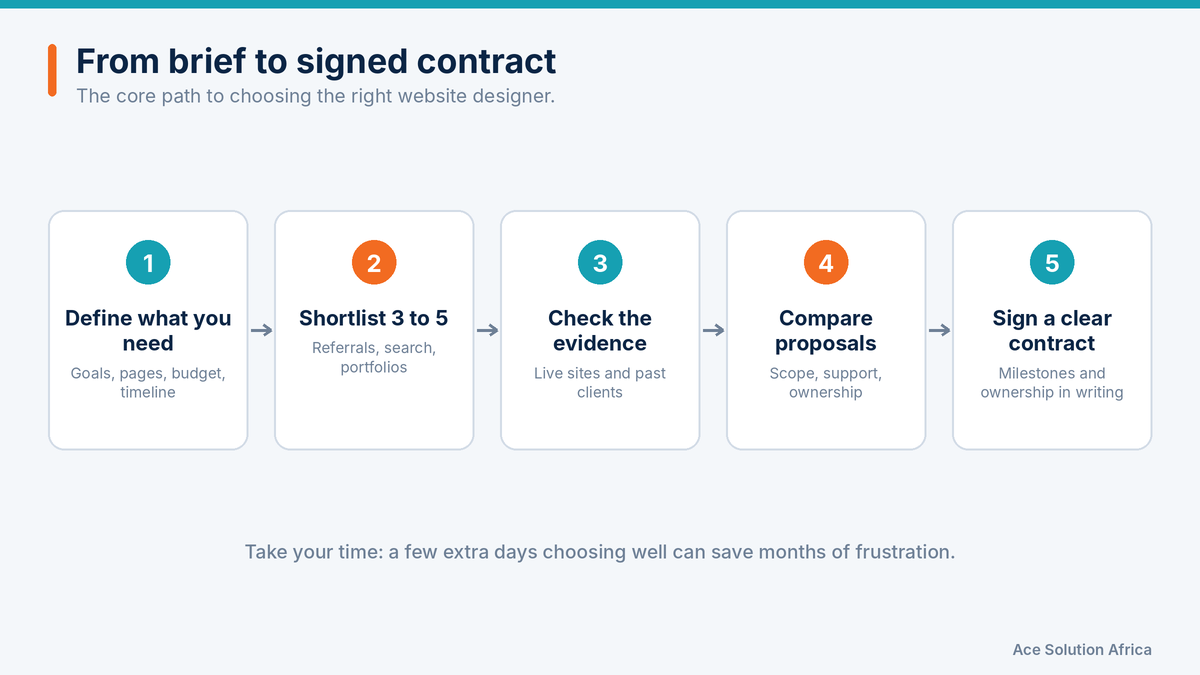
Step 1: Define what you need
The clearer your needs, the easier it is to find the right designer. Write a short brief covering:
- Business overview. What you do, who you serve and what makes you different.
- Goals. For example, generate leads, sell online, take bookings, build trust or support recruitment.
- Audience. Who will visit the site, which devices they use and what they are looking for.
- Pages and features. Home, About, Services, Blog, Contact, shop, booking, gallery, careers and so on.
- Integrations. M-Pesa, card payments, WhatsApp, email marketing, CRM, accounting software.
- Content status. What text, photos and videos you already have.
- Inspiration. Three to five websites you like, and what you like about them.
- Budget range and timeline. Be honest. A good designer will work with realistic ranges.
You do not need to be perfect. Even a one-page brief changes the quality of the conversations you have, and it makes proposals much easier to compare.
Step 2: Decide which type of provider suits you
In Kenya, you will generally choose among four types of website designers. Each has strengths and trade-offs.
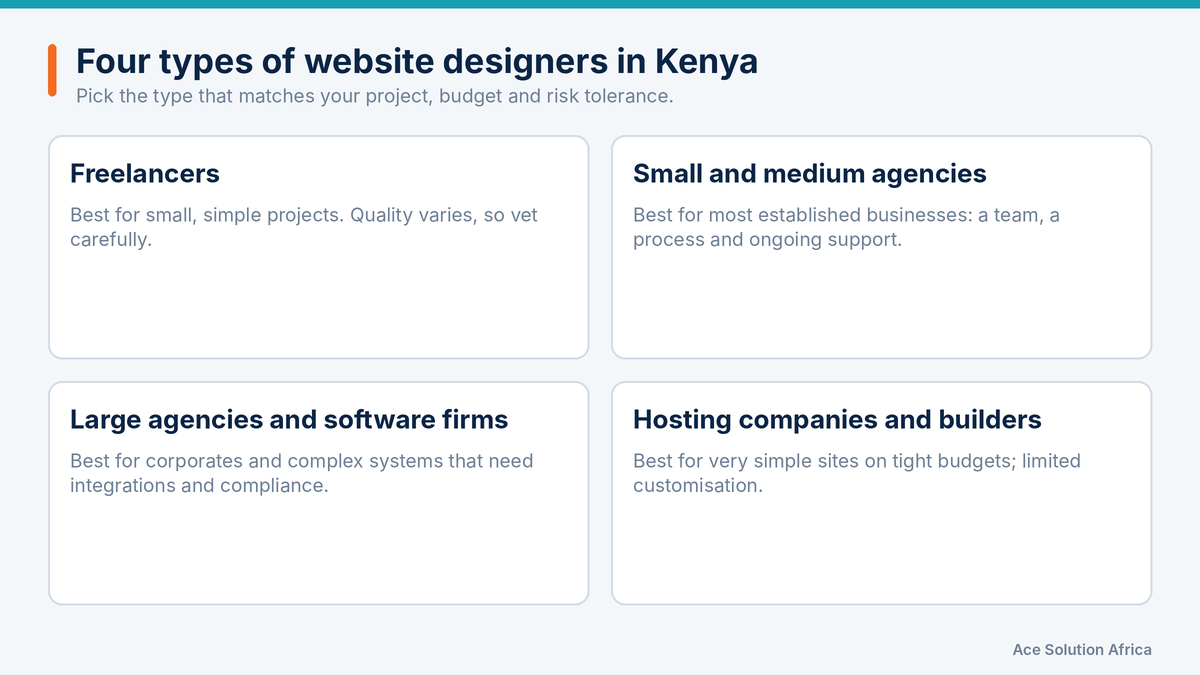
Freelancers
Strengths: Often more affordable, direct communication with the person doing the work, flexibility. Risks: Quality varies widely, availability can be limited, and if the freelancer becomes unavailable you may have no backup. Some freelancers lack processes for security, documentation and long-term support. Best for: Small, simple projects with modest budgets, provided you vet them carefully.
Small and medium web design agencies
Strengths: A team of designers, developers and project managers, structured processes, accountability and typically better support. Many offer a wider range of services, including SEO, content and digital marketing. Risks: Prices are higher than freelancers, and very small agencies may still depend on one or two key people. Best for: Most established small and medium businesses that want professional results and an ongoing relationship.
Large agencies and software companies
Strengths: Deep expertise, capacity for big projects, strong project management, compliance and security practices, and the ability to handle complex integrations. Risks: Higher cost, longer timelines, and smaller projects may receive less attention. Best for: Corporates, government institutions, fintechs and complex platforms.
Hosting companies and website builder providers
Strengths: Convenience, bundled domain, hosting and basic design, often at low prices. Risks: Limited customisation, template-heavy designs, and support that focuses on hosting rather than strategy. Best for: Very simple sites or tight budgets, where speed and cost matter more than uniqueness.
Choosing the right category narrows your search quickly and prevents wasted time with providers who are not suited to your project.
Step 3: Build a shortlist of three to five candidates
Do not try to evaluate twenty companies. Aim for a shortlist of three to five. Good sources include:
Referrals. Ask other business owners whose websites you admire who built them. Personal recommendations are valuable because they come with real experience.
Google search. Search for terms like “website design Kenya,” “web designers Nairobi,” or your location and industry. Agencies that rank well and publish helpful content often (though not always) have solid digital skills. Remember that paid ads at the top of results are not endorsements.
Portfolio footers. Many websites credit their developers in the footer. When you find a site you like, look for “Designed by” links.
Industry associations and directories. Business directories, chambers of commerce and professional groups may list providers.
Social media and LinkedIn. Look at agencies’ recent work, team members and how they engage with clients.
Design and tech communities. Kenya has vibrant developer and design communities online and offline, and members are often happy to recommend trusted professionals.
As you build your list, note why each candidate is on it. This will help you evaluate them consistently.
Step 4: Check the quality of their own website first
An agency’s website is its shop window. If a company designs websites for a living, its own should demonstrate care and competence.
Visit each candidate’s site and ask yourself:
- Does it load quickly on your phone?
- Is the design clean, professional and consistent?
- Is it easy to understand what they do and who they serve?
- Is the content well written, with no obvious spelling or grammar issues?
- Are contact details clear and genuine?
- Do they publish useful blog posts, case studies or guides?
- Is the site secure, with https and no browser warnings?
Do not expect perfection, since agencies are often busy with client work. But glaring problems, such as broken pages, outdated information or poor mobile display, deserve scepticism.
You can also run their homepage through free tools like Google PageSpeed Insights for a quick performance snapshot.
Step 5: Examine their portfolio in depth
A good portfolio demonstrates range, quality and relevance. When reviewing it, go beyond the attractive screenshots.
Open the live websites. Click around on both desktop and mobile. Test forms, menus and search. Look at page speed and overall usability.
Look for relevance. Prioritise designers who have worked on projects similar to yours in industry, scale or functionality. An online shop requires different expertise from a corporate brochure site.
Assess design quality. Look for clear layouts, readable typography, consistent branding, thoughtful use of imagery and obvious calls to action. Good design guides the visitor towards a goal.
Check variety. If every site looks the same, the designer may rely heavily on one template. Variety suggests creative range.
Ask about the process. For two or three projects, ask what the client needed, what the designer proposed, what challenges arose and what results followed. Genuine builders can describe the journey in detail.
Look for measurable outcomes. The strongest case studies mention results such as increased enquiries, improved search visibility, faster load times or higher online sales.
You can get a sense of how a structured service is presented by reviewing the way a professional provider describes its website design services in Kenya, including what deliverables and process stages are typically covered. Use that as a benchmark for the level of detail you should expect from any shortlisted provider.
See how a professional agency presents its work
Review our approach, process and deliverables, then hold every provider you shortlist to the same standard.
Step 6: Talk to past clients
Portfolios show what a designer built. Client conversations reveal what it was like to work with them.
Ask for two or three references, ideally from projects similar to yours, and ask them:
- Did the project finish on time and on budget?
- How well did the designer understand your business?
- How was communication throughout the project?
- Were there hidden costs or surprises?
- How is the website performing?
- What support have you received since launch?
- Would you hire them again?
Pay attention to hesitation. If references sound lukewarm or avoid direct answers, you may have learned something important.
Also search for independent reviews on Google, social media and business directories. Look for patterns. A few complaints are normal for any business, but consistent comments about missed deadlines, poor communication or disappearing after payment are warning signs.
Step 7: Evaluate technical competence in plain language
You do not need to be a developer to assess technical quality. You simply need to ask the right questions and notice how clearly they are answered.
Mobile design. “How do you ensure the site works well on phones and tablets?” A good answer mentions responsive design, mobile-first thinking and testing on real devices.
Speed. “What do you do to make sites load fast?” Good answers include image optimisation, caching, quality hosting, minimising unnecessary plugins and clean code.
SEO. “What SEO work is included at launch?” Look for on-page optimisation, clean structure, sitemaps, Search Console and Analytics setup, and local SEO if relevant. Be wary of absolute guarantees about rankings.
Security. “How do you protect the website?” Expect mention of SSL, firewalls, strong authentication, regular updates and backups.
Platform. “Which platform will you use and why?” The answer should connect to your needs, not just their habits. For many businesses WordPress is a strong fit, while complex systems may need custom development. Our comparison of WordPress and custom website development in Kenya explains how to think about this.
Payments. If you need online payments, ask which providers they have integrated, and specifically about M-Pesa. Ask whether they have worked with Safaricom’s Daraja API directly or through aggregators, and how they handle testing and go-live.
Accessibility and usability. Ask how they approach readability, navigation and forms, since good usability reduces abandonment and complaints.
Notice not just the content but the communication style. A designer who explains complex ideas simply is usually a better partner than one who hides behind jargon.
Step 8: Compare proposals and quotations fairly
Once you have invited your shortlisted designers to quote, you will receive proposals that look quite different. Use a consistent method to compare them.
Check the scope. Number of pages, specific features, design approach, content responsibilities and integrations. Make sure each quote covers the same requirements.
Look at what is not mentioned. Hosting, domain, SSL, email, SEO, training, support and VAT are frequently omitted or unclear. Ask about each.
Assess the process. Does the proposal describe stages, timelines and milestones? Detailed proposals signal professionalism.
Review payment terms. Fair terms involve staged payments linked to deliverables. Avoid providers demanding full payment up front or offering no structure at all.
Consider ownership. The proposal or contract should state that you own the website, content and domain.
Examine support. What does the provider offer after launch? Is there a warranty or free support period, and what are the maintenance options?
Look beyond price. The cheapest quote is rarely the best value, and the most expensive is not automatically the highest quality. Consider the overall package, reliability and fit.
Create a simple comparison table with columns for each provider and rows for scope, price, timeline, inclusions, support, ownership and your overall confidence. Seeing everything side by side often makes the right choice clearer.
Step 9: Ask the questions that reveal quality
These questions help you distinguish serious professionals from salespeople.
- “How do you start a project?” Good providers begin with discovery, asking about goals, audience and competition.
- “Who will actually work on my website?” Understand whether it is the person you are speaking to, a team or subcontractors.
- “What do you need from me, and when?” Strong providers set clear expectations for content, feedback and approvals.
- “How many design revisions are included?” A realistic answer prevents disputes later.
- “What happens if the project scope changes?” There should be a documented change process.
- “Will I be able to update the site myself?” You should be able to edit text, images and blog posts without coding.
- “What are the ongoing costs?” Hosting, domain renewals, licences and maintenance should be transparent.
- “What if I want to leave?” A confident provider will explain how you can take your website, domain and content with you.
- “Can you share an example of a project that did not go perfectly, and how you handled it?” Honest answers reveal maturity and problem-solving ability.
Pay attention to how willing they are to engage with these questions. Defensive or evasive responses suggest potential trouble.
Step 10: Consider the human side
Web projects last weeks or months, and sometimes years if you retain the designer for maintenance and growth. Chemistry matters.
Ask yourself:
- Do they listen carefully, or do they push a pre-set package?
- Do they explain things in a way you understand?
- Do they respect your budget and timeline?
- Are they willing to say no or suggest alternatives when something will not work?
- Do they seem genuinely interested in your business success?
The best designers act as advisers. They challenge unrealistic ideas politely, share relevant experience and aim to build something that works, not just something that looks good in a presentation.
Trust your instincts alongside the evidence. If something feels off, such as pressure to sign immediately or unclear answers, pause and investigate.
Step 11: Review the contract carefully
A professional engagement should be formalised in writing. A good contract or service agreement typically covers:
- Scope of work. Pages, features, integrations and deliverables.
- Timeline and milestones. Key dates and dependencies.
- Payment schedule. Amounts, due dates and conditions.
- Revisions. How many rounds are included and how extra changes are priced.
- Ownership and intellectual property. Who owns the design, code, content and domain upon payment.
- Third-party licences. Responsibility for premium themes, plugins and stock assets.
- Hosting and maintenance. Whether included, for how long and at what cost.
- Confidentiality and data protection. Handling of your business and customer information.
- Support and warranty. Bug-fixing and post-launch assistance.
- Termination. What happens if either side wishes to end the agreement.
If something is unclear, ask for it to be clarified in the document. For larger or higher-risk projects, consider having a lawyer review the agreement.
Ready to put a shortlist together?
Include us. We will share relevant examples, references and a clear written proposal so you can compare fairly.
Warning signs: when to walk away
Some behaviours should make you reconsider immediately.
- Unrealistically low prices that are far below others without explanation.
- Guarantees about search rankings such as “first page of Google in two weeks.”
- Demands for full upfront payment with no milestones.
- No written agreement or reluctance to put promises in writing.
- Refusal to show live portfolio sites or provide references.
- Domain or hosting registered in their name with no transfer arrangement.
- Use of pirated themes or plugins, which pose security and legal risks.
- Template resale presented as custom design.
- Poor communication in the sales process.
- Pressure tactics, such as artificial deadlines for accepting an offer.
- No plan for security, backups or support.
Several of these together are a strong reason to look elsewhere.
Testing the shortlist: a quick evaluation scorecard
To keep your decision objective, assign each candidate a score from 1 to 5 across the criteria below.
| Criteria | Weight | Candidate A | Candidate B | Candidate C |
|---|---|---|---|---|
| Understands my business and goals | High | |||
| Relevant, high-quality portfolio | High | |||
| Positive client references | High | |||
| Technical competence (mobile, speed, SEO, security) | High | |||
| Clear proposal and transparent pricing | Medium | |||
| Ownership and contract terms | High | |||
| Communication and project management | Medium | |||
| Post-launch support and maintenance | Medium | |||
| Value for money | Medium | |||
| Personal chemistry and trust | Medium |
Multiply scores by importance if you want a weighted result, then discuss the top candidates once more before deciding.
How to prepare so the designer can do their best work
The relationship works both ways. A well-prepared client gets better results, faster and often at lower cost.
- Assign one decision-maker. Too many opinions slow projects and blur direction.
- Gather brand assets. Logos, colours, fonts and photos.
- Prepare content. Draft text for key pages, service descriptions, team bios, testimonials and FAQs.
- Provide feedback promptly. Delays on your side can extend the timeline.
- Consolidate comments. Send one clear list of feedback per round.
- Be open to expertise. If your designer suggests changes based on usability or conversion experience, consider them seriously.
- Plan for the long term. Discuss hosting, maintenance and marketing from the start.
Budgeting realistically
Costs vary enormously, so rather than hunting for a specific number, think in tiers.
- Basic sites may cost a modest amount, but often involve templates and limited customisation.
- Professional business sites require more design, content structuring and SEO, and are priced accordingly.
- Ecommerce and custom platforms involve additional complexity, payments, inventory and security considerations.
Remember to include recurring costs for domain renewals, hosting, security and maintenance, along with a budget for marketing so people actually find the site. For a deeper breakdown, see our article on how much website design costs in Kenya, and for stores, our guide to ecommerce website development costs.
What a good working relationship looks like
When you have chosen the right website designer, the project will usually feel like this:
- Discovery. They ask thoughtful questions and learn your business.
- Clear plan. You receive a sitemap, scope and timeline you understand.
- Design previews. You see concepts early and have a chance to refine them.
- Steady progress. Regular updates keep you informed, and problems are raised early.
- Testing. The site is checked across devices and browsers before launch.
- Smooth launch. Domain, hosting, analytics and search tools are set up correctly.
- Training and handover. You know how to manage your site and have all access details.
- Ongoing support. Someone responds when you need help.
If your experience departs significantly from this pattern, raise concerns early, politely and in writing.
The case for local expertise
Kenya has a distinctive digital landscape. Most users are on mobile. WhatsApp is a primary business communication channel. M-Pesa is the dominant mobile payment method. Many customers search for services “near me” and rely on Google Maps and Business Profiles. Data protection rules and consumer expectations have evolved significantly.
Designers who work in this environment every day understand these realities. They are better placed to build sites that load well on typical devices and connections, integrate local payment methods, support local SEO and reflect local customer behaviour. When you are choosing among otherwise similar candidates, local experience can tip the balance.
This does not mean you should exclude international designers. It does mean that for a Kenyan audience, you should confirm that anyone you hire understands local conditions and can support you in your time zone.
You can see an example of how a locally focused provider outlines its approach on our page about website design in Kenya, which is a useful point of comparison as you evaluate other options.
Frequently asked questions
How many designers should I get quotes from?
Three to five is a good range. Fewer limits your perspective, and more can create confusion and waste time.
Is it better to hire a freelancer or an agency?
It depends on the project’s complexity and your tolerance for risk. Freelancers can offer excellent value for simple projects. Agencies provide teams, structure and continuity, which suit business-critical sites and long-term relationships.
Should I pay a deposit?
Yes, a deposit is normal and fair, typically a portion of the total, with further payments linked to milestones. Be cautious of requests for the entire amount up front.
How long should the project take?
A simple site may take a couple of weeks, a typical business site three to six weeks, and larger projects longer. Delays often come from late content or feedback, so be prepared.
What if I already have a website that is not working?
Ask for an audit before committing to a redesign. A good designer will assess performance, structure, content and technical health, and tell you whether to improve, rebuild or restructure.
Will the designer handle SEO?
Basic on-page SEO should be part of a professional build. Ongoing SEO, such as content creation and link building, is usually a separate service. Clarify expectations in writing.
How do I know if a designer is using pirated software?
Ask which themes and plugins they use and whether licences will be registered in your name. Reputable providers can show licence details. Unusually low prices combined with premium-looking features can be a hint.
Can I change designers later?
You should be able to, provided you own your domain, hosting access, files and content. This is why ownership terms matter so much.
Final checklist
Before you sign, make sure you can tick each of these.
- I have a clear brief and budget range.
- I have compared at least three providers.
- I have reviewed live portfolio sites on mobile and desktop.
- I have spoken to at least two past clients.
- I understand exactly what is included in the price.
- I know who owns the domain, website, code and content.
- Security, backups and mobile performance have been discussed.
- Payment terms are staged and written down.
- Support and maintenance options are clear.
- I trust the people I will be working with.
Conclusion
Choosing the best website designers in Kenya is less about finding a famous name and more about finding the right fit: a team or professional who understands your goals, builds secure and fast websites, communicates honestly, protects your ownership and stays available when you need them.
Take the time to define your needs, build a shortlist, scrutinise portfolios, speak to past clients, compare proposals carefully and insist on clear written terms. The effort is small compared with the cost and frustration of choosing badly.
If you would like to talk through your project with a team that works with Kenyan businesses every day, you are welcome to explore our approach to website design in Kenya and get in touch. We will gladly share relevant examples, answer your questions and help you decide whether we are the right fit, or point you in the right direction if we are not.
Talk to a team that works with Kenyan businesses every day
Whether we are the right fit or not, you will leave the conversation clearer about what to do next.
Related Posts

Ecommerce Website Development Costs in Kenya: A Complete Guide
November 23, 2026
Why Your Business Needs a Professional Website
November 23, 2026
LET'S BUILD SOMETHING GREAT
Ready for a better website?
Get a modern website designed around your business, goals, and budget.
Ready to Get Started?
Let's Build a Website That Works for Your Business
Whether you need a professional business website, an ecommerce store, a corporate website, or a complete digital growth strategy, our experienced team is ready to help you achieve your business goals online.
💼
View Our Recent Projects
Explore websites we've designed for businesses across different industries and discover what's possible.
View Projects📞
Book a Free Discovery Call
Speak with one of our website consultants, ask questions, and get expert guidance before making your decision.
Book a Free Call