

Table of contents
Walk through any busy street in Nairobi, Mombasa or Kisumu and you will see businesses everywhere: salons, restaurants, hardware shops, law firms, schools, clinics, boutiques, logistics companies, tour operators. Many have signboards, a few have social media pages, and a surprising number still have no website at all.
“Our customers find us through WhatsApp.” “We have an Instagram page, so we are fine.” “Our business is small. Do we really need a website?” These are reasonable things to say, and they are exactly what thousands of business owners say every year. Yet the businesses that grow fastest, win bigger clients and build lasting reputations almost always share one thing: a professional website that works as hard as they do.
This article explains, in practical terms, why your business needs a professional website, especially in Kenya’s mobile-first, M-Pesa-powered market. We will cover credibility, visibility, lead generation, sales, customer service, cost-effectiveness, competition and long-term brand building. We will also address the common objections, such as “social media is enough,” and show what separates a professional website from a poor one.
The way customers find businesses has changed
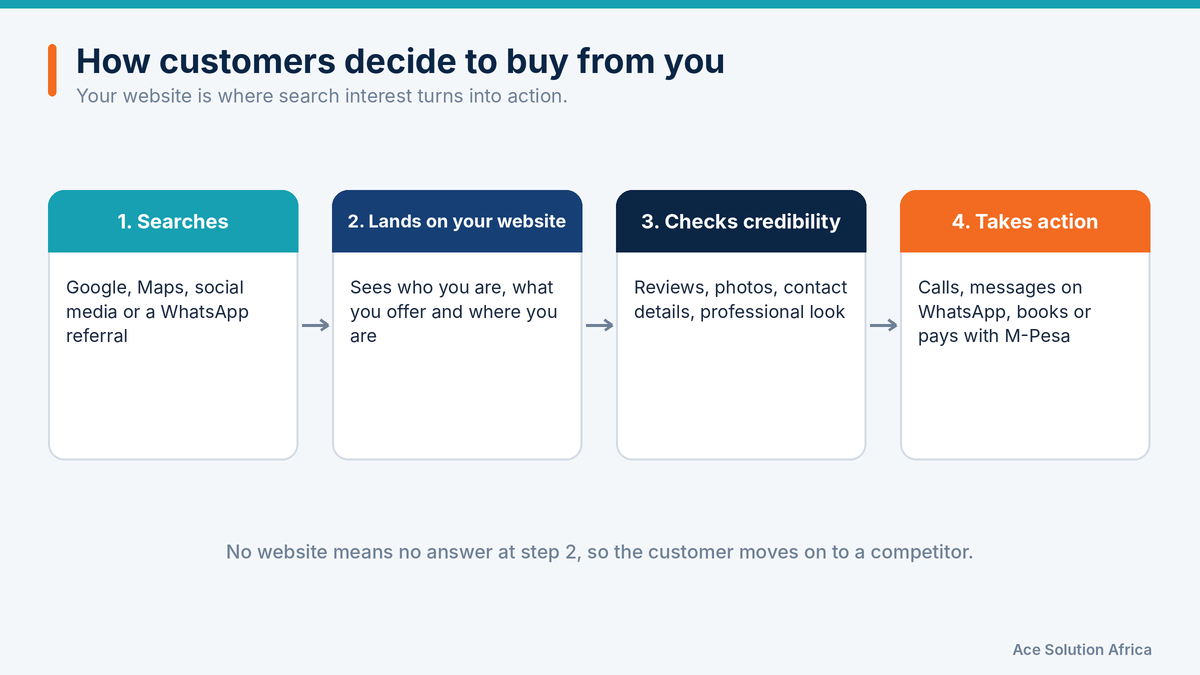
Think about how you search for a product or service yourself. If you need a plumber, a dentist, a wedding venue, a school for your child, a conference venue or an accountant, what do you do? Most people pick up their phone and search on Google, check Google Maps, ask on WhatsApp groups, look at social media or ask friends who then look online.
Whichever route is used, the next step is nearly always the same. They look for evidence: Is this business real? Is it professional? Where is it? What does it offer? How much does it cost? Can I trust it? A professional website is the one place where you control the answers to every one of those questions.
Kenya has one of the most active mobile internet populations in Africa. Smartphones are widespread, mobile data is a normal part of daily life, and customers are comfortable researching and paying online. Your potential customers are already online. The only question is whether they find you, and what they think when they do.
1. A professional website builds instant credibility
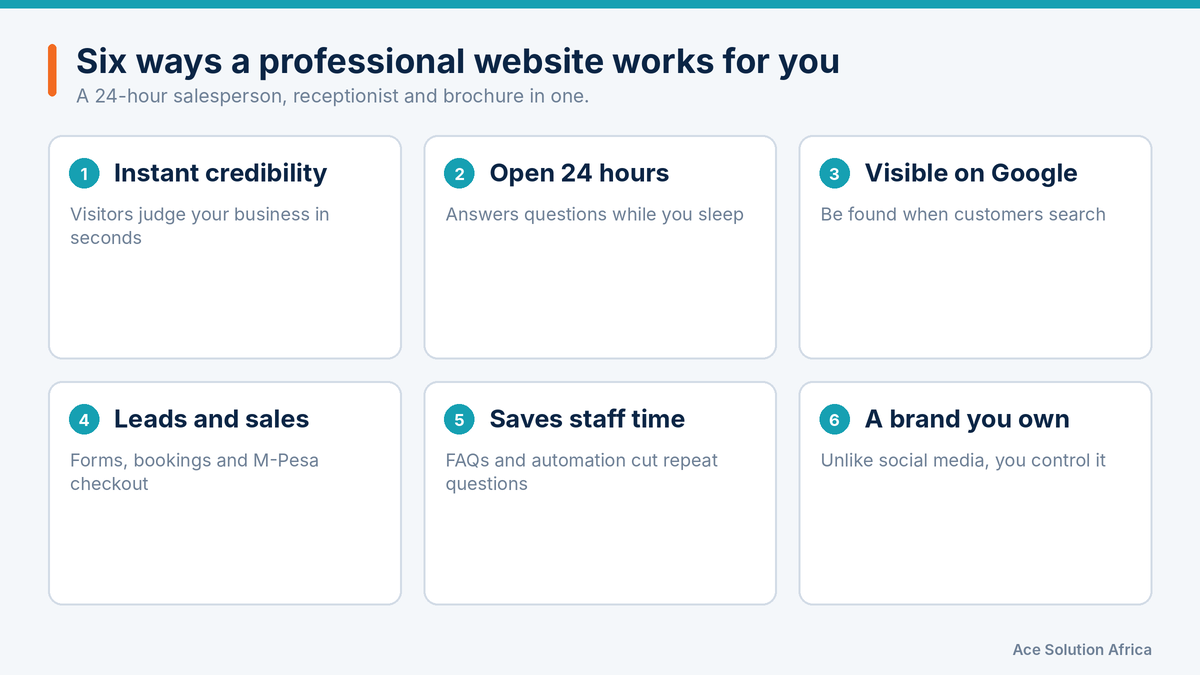
People judge quickly. Research on web behaviour repeatedly shows that visitors form an impression of a website within a fraction of a second, and that impression shapes how they view the business behind it. A clean, modern, fast, mobile-friendly website signals competence and reliability. An outdated, cluttered or broken one signals the opposite, however good your actual service may be.
Consider two businesses offering similar services. One has a professional website with clear descriptions, photos, testimonials, contact details and a physical address. The other has only a Facebook page with irregular updates. Which one would you trust with your money, particularly for a high-value purchase or a service you cannot easily inspect in advance?
Credibility matters even more when:
- Customers are spending significant amounts.
- Buyers are comparing several suppliers.
- You are targeting corporate clients, NGOs or government institutions that conduct due diligence.
- You serve customers who are not nearby, such as diaspora Kenyans, tourists and international buyers.
- You are a newer business without a long reputation.
A professional email address on your own domain, such as info@yourbusiness.co.ke, adds to that credibility. It looks far more established than a free webmail account, and it keeps your brand consistent.
2. Your business is open 24 hours a day
Your shop closes. Your office closes. Your phone line gets busy. Your website never sleeps.
At two in the morning, a potential customer can read about your services, browse your products, check your prices, look at photos of your previous work and send an enquiry. A professional website works as a sales assistant, receptionist and brochure rolled into one, answering common questions and capturing leads while you are asleep or serving other customers.
This matters in a country where many people work long hours and do their research in the evening, at lunchtime or on the commute. If your competitor’s website answers questions at 9 pm and yours does not exist, you have lost the lead before you even knew it existed.
3. A website makes you visible on Google
Visibility is the engine of growth. If people cannot find you, they cannot buy from you.
Search engines such as Google help customers find businesses by matching their queries with relevant web pages. Without a website, you largely cannot appear for searches such as “best catering services in Nairobi,” “electrician in Nakuru,” “private school in Kiambu” or “wedding photographer Mombasa.” A well-built website, optimised for search engines, gives you the chance to appear in those results.
A professional website supports your visibility in several ways:
- On-page SEO. Proper page titles, headings, descriptions, image labels and clean structure help search engines understand what you offer.
- Local SEO. A website that clearly displays your address, service areas and contact details, paired with a well-managed Google Business Profile, improves your chances of appearing in local results and on Google Maps.
- Content marketing. Articles, guides and FAQs answer real customer questions and attract visitors who are researching their options.
- Authority and trust signals. Reviews, case studies, certifications and consistent information build confidence with both visitors and search engines.
Be realistic: SEO takes time, and nobody can honestly guarantee a specific ranking. But without a website, you are largely invisible in search. With one, you are in the game.
4. It generates leads and sales
A professional website is not just an online brochure. It is a conversion tool designed to turn visitors into enquiries, bookings, calls and orders.
Lead generation. Well-designed contact forms, quote request forms, click-to-call buttons, WhatsApp links and booking tools make it easy for interested visitors to take the next step. Clear calls to action, such as “Request a Quote,” “Book a Consultation” or “Order Now,” guide them.
Online sales. If you sell products, an ecommerce website lets customers browse, choose and pay without visiting your shop. With M-Pesa and card payment integration, they can complete purchases in moments from their phones. Our guides on ecommerce website development costs in Kenya and integrating M-Pesa into your business website explain how this works.
Bookings and appointments. Clinics, salons, consultants, tour companies, restaurants and event venues can take bookings online, which reduces phone tag and no-shows.
Better quality enquiries. When customers read your website first, they arrive more informed. They already know your services, locations and basic pricing, so conversations are more productive and conversion rates are often higher.
Measurable results. Tools like Google Analytics and Search Console show how many people visit, where they come from, which pages they read and how many take action. You can see what works and improve it, which is nearly impossible with a signboard or flyer.
Turn visitors into enquiries and orders
We design websites with clear calls to action, fast mobile pages and M-Pesa checkout so visitors become customers.
5. It reduces your workload and improves customer service
How many times a day do you or your staff answer the same questions? “Where are you located?” “What time do you open?” “How much does it cost?” “Do you deliver?” “How do I pay?” A professional website with clear information, FAQs and downloadable documents answers these questions automatically.
That frees your team to focus on high-value conversations and delivery. Additional benefits include:
- Self-service. Customers can check order status, download invoices, read policies or access resources without calling.
- Consistent information. Everyone sees the same, accurate details, which reduces misunderstandings.
- Faster responses. Contact forms, chat and WhatsApp integration route enquiries efficiently.
- Automation. Booking confirmations, payment receipts and email follow-ups can be sent automatically.
For growing businesses, these efficiencies can be as valuable as the extra leads.
6. Social media is not enough
This is the most common objection, so it deserves a serious response. Social media is powerful, and you should absolutely use it. But it works best as a complement to a website, not a replacement.
You do not own your social media presence. Platforms change algorithms, policies and features constantly. Your reach can drop overnight, accounts can be suspended or hacked, and the platform can disappear or lose popularity. A website on your own domain is an asset you control.
Social platforms are crowded and noisy. Your page competes with entertainment, news, ads and personal posts. A website is a focused space where visitors see only your message.
Search discovery is limited. Social posts are not designed to answer long-term search queries in the same way as web pages. Customers searching Google for a service are much more likely to find a website than a social media profile.
Limited design and structure. Social pages follow a fixed template. A website lets you organise information, present your brand, show detailed services, publish in-depth content and build a conversion journey.
Credibility gap. Many customers, especially corporate buyers and higher-value clients, expect a business to have an official website. Not having one can raise doubts.
Data and analytics. On your own site you can track visitor behaviour, build email lists and run remarketing in ways that fit your needs, without depending on a platform’s rules.
The ideal setup is a professional website at the centre, supported by social media that drives people to it. Your social channels attract attention and engagement, and your website converts that attention into business.
7. A website is cost-effective compared with traditional marketing
Traditional marketing channels such as print adverts, billboards, flyers and radio can be expensive, and their results are hard to measure. A website, by contrast, is a one-time build with modest recurring costs, and it keeps working for years.
You can see how a project is typically structured, and what a professional site includes, in our overview of website design in Kenya. Costs vary with scope, but compared with the lifetime value of the customers a good website can bring in, the investment is often small. Winning a few extra clients a year may well pay for the site many times over.
A website also supports your other marketing. Business cards, brochures, posters, adverts and social posts can all point to your site, where interested people can find full details and take action.
Bear in mind that a website is not free once it launches. You need to budget for hosting, domain renewals, security, maintenance and some form of marketing. But these ongoing costs are typically modest compared with many alternatives, and the returns can be significant.
8. It gives you a competitive advantage
In some industries in Kenya, many competitors already have professional websites, so having one is simply keeping up. In others, a good website remains rare, which means a strong online presence can set you apart immediately.
Ask yourself:
- When a customer searches for your type of business, which competitors show up?
- How do their websites look and feel compared with yours?
- Do they have online booking, ecommerce or live chat that you lack?
- Are they publishing content that positions them as experts?
A professional website lets you compete above your size. A small company with a polished, informative site can look as credible as a large one. A local business can reach customers in other towns, counties or countries. Without a website, you may lose business to competitors that look more established, even if your service is better.
9. It allows you to accept payments conveniently, including M-Pesa
Payments are central to modern commerce, and in Kenya that means mobile money. M-Pesa is deeply embedded in daily life, and customers expect to pay with it. A professional website can integrate payment options such as M-Pesa STK Push, cards and bank-linked gateways so that customers can pay for products, services, deposits, bookings, school fees, subscriptions, donations or invoices without friction.
The benefits include:
- Faster cash flow. Customers pay immediately rather than promising to send money later.
- Fewer errors. Automated confirmation and reconciliation reduce mistakes compared with manually checking M-Pesa messages.
- Better customer experience. A smooth checkout reduces abandoned purchases.
- Wider reach. Customers anywhere in the country can pay without visiting your premises.
- Data and records. Transactions are logged and can be tracked in reports.
If you are considering online payments, ask your web designer how they will integrate and test the payment flow, and whether they have experience with Safaricom’s Daraja API and other payment providers.
10. It helps you build and protect your brand
Your website is the digital headquarters of your brand. It tells your story, communicates your values and presents your products or services in a consistent, controlled way.
A professional site contributes to brand-building by:
- Showcasing your identity. Logo, colours, tone of voice and imagery work together.
- Telling your story. An About page, team profiles and case studies humanise your business.
- Displaying proof. Testimonials, client logos, awards, certifications and reviews strengthen trust.
- Controlling your narrative. You decide how your business is described, rather than relying only on third-party listings or social posts.
- Protecting your name. Owning your domain name stops others from using it and gives you a stable online home.
Over time, a consistent and professional online presence turns into reputation. People remember brands that look reliable, communicate clearly and make life easy.
11. It helps you attract talent, partners and investors
Customers are not the only audience for your website. Job seekers check a company’s site before applying. Potential partners and suppliers want to understand who you are. Investors, lenders and funders often start their due diligence with a web search.
A professional website with clear information, a careers page, company background and contact details signals that you are an organised, serious business. This can help you:
- Attract better candidates, who see you as a credible employer.
- Win tenders and corporate contracts, where procurement teams check supplier credibility.
- Build relationships with distributors, partners and associations.
- Support funding applications and investor conversations.
For NGOs and social enterprises, a strong site also supports donor communication, reporting and transparency.
12. It supports business growth and scalability
A website can grow with your business. You can start with a modest site and add features as your needs evolve: an online shop, booking system, customer portal, additional languages, new service pages, a blog, a learning platform or integrations with accounting and CRM software.
Because digital channels are scalable, handling 1,000 visitors does not usually require ten times the staff needed for 100. A good system can serve many customers simultaneously, which is difficult to achieve with purely physical operations.
A website also gives you data to guide decisions. Which services get the most views? Which regions generate the most enquiries? Which campaigns bring buyers? These insights help you invest where it counts.
What makes a website "professional"?
Having a website is not enough. A poor website can damage your reputation as much as having none. Here is what distinguishes a professional site.
Clear purpose and messaging. Visitors should understand within seconds what you do, who you serve and what to do next.
Professional design. Clean layout, consistent branding, readable typography and quality images that reflect your business.
Mobile-friendly. Since most Kenyan users browse on phones, the site must be designed for small screens, with easy navigation, tappable buttons and quick loading.
Fast performance. Pages should load quickly, even on mobile data. Slow sites frustrate visitors and can hurt search visibility.
Easy navigation. Logical menus, clear page structure and an obvious path to contact or purchase.
Strong content. Well-written, accurate, useful text and good photography. Content should be original and tailored to your audience.
SEO foundation. Proper technical setup, relevant keywords, clean URLs, sitemaps and local information.
Security. SSL certificate, regular updates, backups and secure forms and payment handling.
Clear calls to action. Buttons and forms that invite visitors to call, book, request quotes or buy.
Trust signals. Contact details, address, testimonials, certifications, privacy policy and terms.
Analytics. Tracking tools that show how the site performs.
Maintainability. A platform that lets you update content easily, supported by proper maintenance.
If you want to see how these elements fit together in a structured project, look at our page about professional website design in Kenya, which outlines the kind of deliverables you can expect from an experienced provider.
Get a website that looks professional and performs
Mobile-first design, SEO foundations, security and training, delivered by a local team that stays with you after launch.
Signs your business needs a website (or a better one)
You probably need a new or improved website if:
- You have no website at all.
- Your current site was built many years ago and looks outdated.
- It is difficult to use on a phone.
- It loads slowly or often goes offline.
- It does not appear in Google when people search for your business name or services.
- It does not clearly explain what you do or how to contact you.
- You constantly answer the same questions manually.
- Competitors seem to be winning enquiries that should have come to you.
- You cannot easily update it yourself.
- It has been hacked or displays security warnings.
- You are losing sales because customers cannot pay online.
Any one of these suggests an opportunity to improve.
Common myths about business websites
"I am too small for a website."
Small businesses often benefit the most, because a website helps them look credible and reach customers they would otherwise never meet. A modest site can be enough to start.
"A website is too expensive."
Prices vary, and there are options for different budgets. Compared with the value of new customers, a professionally built site can be one of the best investments in marketing. The cost of not having one, in lost enquiries and credibility, is real even if it is invisible.
"My customers are not online."
Even customers who prefer to buy offline often research online first. And more customers are online than many owners realise.
"I will just use a free website builder."
Free or very cheap builders can be a starting point, but they often come with limited design, restricted features, branding from the platform and weaker SEO. For a business that depends on its website, a professional build is usually a better investment.
"Once the site is built, I am done."
A website is a living asset. It needs updates, fresh content, security care and performance monitoring. Treat it like a shopfront that needs regular maintenance.
"A website will instantly make me rich."
A website is a powerful tool, not a magic wand. Results depend on strategy, content, marketing, service quality and consistency. Be wary of anyone who promises overnight success.
How to get started
If you are convinced and ready to move forward, here is a simple roadmap.
- Define your goals. Decide what you want the site to achieve, such as leads, sales, bookings or credibility.
- Know your audience. Think about who you want to reach and what they need to know.
- Secure your domain name. Choose a short, memorable name, ideally matching your brand, and register it in your own name.
- Plan your pages and content. Home, About, Services or Products, Testimonials, Blog, Contact, and any special features.
- Choose the right partner. Compare providers, review portfolios, check references and clarify ownership and support. Our guide on how to choose the best website designers in Kenya walks through the process.
- Set a realistic budget. Include design, hosting, maintenance and marketing. See our article on website design costs in Kenya for planning ranges.
- Prepare content and images. Good photos and clear text make a big difference.
- Launch and promote. Set up analytics and Google Business Profile, share the site on social media and add the address to business cards, email signatures and adverts.
- Measure and improve. Review performance regularly and keep adding value with fresh content and improvements.
Industry examples
Professional services (law, accounting, consulting). Clients want proof of expertise and trust. A site with service pages, profiles, case studies and articles builds authority and attracts enquiries.
Healthcare. Patients look for locations, services, doctors and appointment options. A clear, secure, mobile-friendly site with booking capabilities reduces calls and improves access.
Education. Parents and students want curriculum details, fees, calendars, news and admissions information. A website serves as a central communication hub.
Hospitality and tourism. Imagery, reviews, rates, availability and maps are decisive. A site that supports enquiries or direct bookings reduces dependence on third-party platforms and commissions.
Retail and ecommerce. Product catalogues, secure checkout, M-Pesa payments and delivery information turn browsing into sales.
Real estate. Property listings with galleries, maps and enquiry forms help agents reach buyers and tenants.
Manufacturing and construction. Corporate credibility, project portfolios, certifications and tender-friendly information help win contracts.
NGOs and community organisations. Transparency, impact stories, reports and donation options engage supporters and funders.
Trades and local services. Even a simple site listing services, service areas, reviews and contact options can generate steady local leads.
Protecting your investment
Once your website is live, protect its value.
- Keep software updated. Regular updates and security patches reduce risk.
- Back up regularly. Ensure you can restore the site quickly if something goes wrong.
- Monitor uptime and performance. Know when the site is down or slow.
- Refresh content. Update services, prices, team information, offers and blog posts.
- Respect data protection. If you collect personal data, follow applicable laws such as Kenya’s Data Protection Act, publish a clear privacy policy and handle information responsibly. Seek legal advice for your specific obligations.
- Review analytics. Learn from the numbers and refine your approach.
- Invest in visibility. Combine SEO, social media, email and, where appropriate, paid advertising to bring in visitors.
The cost of not having a professional website
It is tempting to think that skipping a website saves money. In reality, the costs are hidden:
- Customers who search and cannot find you
- Prospects who doubt your credibility
- Enquiries that go to competitors
- Repeated manual explanations that waste staff time
- Missed opportunities with corporate, international and online customers
- Dependence on platforms you do not control
These losses rarely appear on a balance sheet, but they add up. Businesses often discover the gap only when they compare themselves with a competitor who invested early.
Final thoughts
A professional website is no longer a luxury for large corporations. It is a basic business tool, as essential as a business card, a phone line or a shopfront. It builds credibility, makes you visible, generates leads and sales, saves time, supports payments and gives you a platform to grow.
The best time to build a website was when you opened your business. The second-best time is now. Start with clear goals, choose a reliable partner, plan for security and maintenance, and treat your site as a living asset that earns its keep.
If you are ready to take the next step, our team would be glad to help you plan a website that fits your business, your budget and your customers. Learn more about our website design services in Kenya and contact us to discuss your goals. A conversation costs nothing, and it may be the start of your best marketing investment yet.
Start your professional website today
Tell us about your business and we will propose a website that fits your goals and your budget.
Related Posts

Ecommerce Website Development Costs in Kenya: A Complete Guide
November 23, 2026
How to Choose the Best Website Designers in Kenya
November 23, 2026
LET'S BUILD SOMETHING GREAT
Ready for a better website?
Get a modern website designed around your business, goals, and budget.
Ready to Get Started?
Let's Build a Website That Works for Your Business
Whether you need a professional business website, an ecommerce store, a corporate website, or a complete digital growth strategy, our experienced team is ready to help you achieve your business goals online.
💼
View Our Recent Projects
Explore websites we've designed for businesses across different industries and discover what's possible.
View Projects📞
Book a Free Discovery Call
Speak with one of our website consultants, ask questions, and get expert guidance before making your decision.
Book a Free Call